The panorama on the sunrise side: an awesome view of Malarayat

The quiet panorama on the sunrise side of the farm: an awesome view of Mount Malaráyat and the river below the gap.

01 July 2011

Harvesting Coconuts

Búko actually means a young, immature fruit or a flower that has yet to open, and may refer to a variety of plants, not just coconuts. But by sheer profusion and popularity, the term has been so closely associated and often mistaken as the Tagalog of the coconut fruit (and the tree).


The Tagalog for coconut (Cocos nucifera) is niyóg, and if you leave it to mature on the tree, it will dry up, shrink a bit and turn brown. But most prefer to harvest it when it is still young, large and green (right), in its búko stage.


And understandably for good reason! My favorite is "búko juice" which is the cool, clear water inside, then scooping out the gelatinous flesh, all fresh from the shell! It's a defining pleasure you can only have by living in the tropics.


Periodically, magpapakyáw 
(contractors or middlemen) come and purchase all the harvest-able búko in the farm. We have no means to do this on our own: climbing  a couple of hundred trees is pretty daunting already, and some are four- to five-storeys high!


It's fascinating to see the coconut farmers busy with their work. With spikes on their shoes, they climb up the trees with a chain harnessed around their waists, then they go about knocking on the coconuts like it's as simple and easy as a desk job.


The good ones they select, they hook the entire buhîg (bunch?) into some rope, and let it slide down (right), carefully making sure the coconuts don't come down to the ground a-crashing (when we do it ourselves, we always end up with broken coconuts!).


They have to be collected at the foot of each tree and manually transported to the gate where the truck is. Now this smiling worker on the left makes it look so light and easy but the coconuts he's carrying on his pinggâ is as heavy as your two-piece, maxed-out, checked-in luggage!

27 June 2011

The River


At the far end of the farm, below a ravine is a small river. At present, it is still a steep and rough hike down (and an equally tough climb going up), which somehow keeps the area inaccessible.


Meantime, we have planted a lot of hardwood seedlings on the hike down, local trees like mulawin, narra, daô, cúpang, ditâ, ýlang-ýlang and yakál. We did so not only for aesthetic purposes but also to hold the soil together before we even think of doing anything with it. As it is now, it is already enchanting: strangler figs with strange-looking berries and wild palms (especially fishtails and sugar palms, locally called káong), forest birds and trees I have never even seen cover the slope. What more just after a couple of years? After all, it's good that it is not yet easy to reach as this gives us time to let the area re-generate as organically as possible.


The waters are from Malarayat, no doubt and even though I have been to the river more than a dozen times, it has never looked the same every time I go down there. The atmosphere in the river changes more often than any other area in the farm.


There are lush ferns (above) that naturally grow on the banks and some rocks, including the edible pakô which always flourish after some rain. There are small fish, and on our side, there are even two natural springs. In time, I will build a stairway going down, but meanwhile, enjoy the photos :)


My German Shepherd, Vitra, then still a pup.

Ubod

Sometimes, for whatever reason, we would have one or two felled coconut trees. When we were building, we had to clear some areas and there were a couple of trees, especially coconuts that were in the way.

Now I'm not sure if many people know where the úbod in fresh lumpiâ comes from. I somehow knew before that it's a coconut by-product and figured that, I guess it comes from the coconut itself (which, by the way, is not a nut but that's a totally different story altogether).

It turns out that úbod is Tagalog for pith, the young core of the trunk of the coconut tree (or the banana, whose ubod can be eaten too). On the right, we chopped off the top part of the felled tree (background) and skinned the bark to get the pith (lower part/foreground).

It's very nutritious to eat, fibrous (since this is what will become coco lumber in time), and filling. Imagine: from the roots underground, the tree absorbs water and nutrients, goes up the pith, and into the leaves, the flowers, and into the coconuts. Amazing.

Traditionally, we cook it as lumpiâ filling, sauteed and mixed with some kincháy (something like flat parsley) and small shrimps, to flavor. Anyone out there who has some new recipe to share?

26 June 2011

Coffee


At its very core, 1784 has been and will always be a coffee farm. We grow three of the four commercially-grown varieties in the Philippines: Robusta (shown above), Excelsa, and Liberica (the other is Arabica which is best grown in high elevations).

Usually triggered by the tropical winter solstice, the coffee trees (as with a lot of other flowering and fruit-bearing plants) instinctively pro-create and flower after it experiences a profound change in weather. Apparently, the change shocks them enough to jar their complacent nature and in an inherent desire to survive, the trees willfully preserve their line by flowering.

In time, these same flowers become the cherries that are initially colored green and will become red when ripe. The cherries take anywhere between eleven to twelve months to mature before it is ready to be manually picked from the tree (Tag. pagpupúti). In fact, we don't necessarily pick an entire tree in one go as sometimes, some cherries even from the same branch mature ahead of the others so they have to be selected with keen eyes and a good sense of touch.


Liberica is another variety (shown above) with unusually-bigger cherries than Robusta and Excelsa (and Arabica). Some cherries are twice the size of the rest, thus it is locally nicknamed Barako, the Tagalog for "stud" and connoting an Alpha characteristic among a group or breed. Undoubtedly, it has a richer and more intense aroma and flavor than Robusta, at least.

Our Robusta trees are neatly planted on a grid between coconut trees. When we acquired the farm, the trees were scrawny, extremely tall and overtaken by ants. We let the season pass and after harvesting, we pruned them meantime to keep the trees low, easier to maintain, and hopefully prolific.

June Bird of the Month


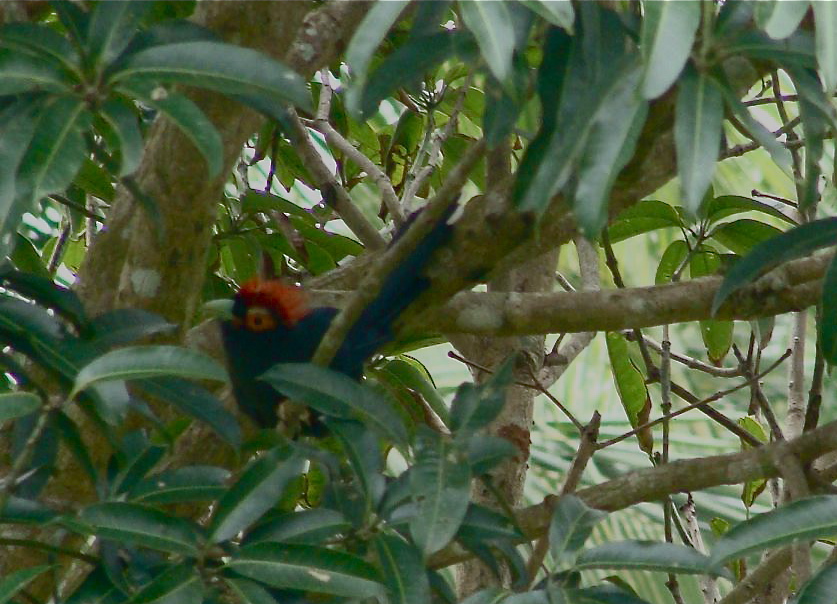
The Red-Crested Malkoha is the bird that gives its name to our place. Indigenous to Luzon and some parts of the Philippines, it is locally called Manoc-manoc or Tamsiya. Here in the Malarayat foothills and apparently in the neighboring areas within Mounts Makiling and Banahaw, the Red-Crested Malkoha is a fairly common sight but still relatively unknown to everyone.


This is strange as the Malkoha has a very striking appearance: a mid-sized bird with bold colors of black, white, red and green. A conspicuous visitor to the fern garden and the mango orchard, sometimes in pairs but more frequently alone. It has glossy black feathers, a green beak, and bright red plumes on its head. It's fairly easy to photograph it since it flies low, and takes short flights between trees.