The panorama on the sunrise side: an awesome view of Malarayat

The quiet panorama on the sunrise side of the farm: an awesome view of Mount Malaráyat and the river below the gap.
Showing posts with label landscaping. Show all posts

11 July 2012

Piedra China


We found a great deal offering one lot of piédra chína, numbering around forty hefty and heavy blocks of dense, raw stone yet naturally polished over hundreds of years. They are of similar sizes but are all uneven; no two pieces are exactly alike. Some are squarish, some have slants. Some have a tinge of pink, while some have longer and shorter sides.

It was both challenging and exhausting to lay them out! I wanted them to look randomly,  naturally in place, as if it has always been there, organically part of the landscape. It has a very practical purpose: I needed to connect the entrance driveway through the muláwin gate all the way to the cabáňa with a solid pathway as it always gets either dusty or muddy to walk through.


It was extremely back-breaking to establish a pattern, through trial and error, with stones as heavy as tree trunks! Not only are they uneven (above left and right), I also needed to make the path curve as gracefully and effortlessly as possible.

Their thicknesses also vary widely, so the depths we had to dig to make the finish with an even surface was different for each piece! In the end (below), all the hard labor paid off with a handsomely paved walkway gracing our garden's foyer.


21 June 2012

Sansevieras

Hardy plants that are so easy to grow are Sansevieras, a family of succulents that are not only almost fail-proof but will actually even tolerate neglect. Given the right spot in the landscape or potted in a proportionate container, sansevieras are very useful to fit into any garden or interior.

On the right is the Sanseviera trifasciata, nicknamed the Snake plant or sometimes even more sinister, the Mother-in-law's Tongue. Not many people know that with enough space, this will grow waist

high or even a little more, making it a useful border plant.

There is a variegated version, equally if not  even more popular (left). It has yellow borders that define the leaves' shapes, and gives it a flaming look. Recently, we've tried mixing both the plain and the striped into the same pot but it is taking quite some time to make it look natural and casual.

There are also dwarf versions of both, pictured below.

07 June 2012

Aralias


Aralias (Polyscias) are foliage plants which beautifully fill in gaps in a landscape or serve as breaks in an otherwise monotony of stellar plants all trying to catch one's attention, putting on a supporting role to complement and complete a grouping of colorful tropical plants. They're generally bushy and each variety grows into a rich tapestry of textures and hues. That said, it's so easy trim them as their free form will always find a way to balance itself. They would also look handsome as potted specimens and will even thrive partially indoors.


02 April 2012

Pandan


One of my most favorite landscaping plants is the Screw Pine (Pandanus, Tag. pandán), especially P. sanderi (above) which I first saw on the cover of a local landscaping book maybe twenty or more years ago. The plant (and the book cover) left an imprint in my memory so much so that since then, I always imagined a big Pandan just like in the photo above to lord over the future garden in my mind.

We planted the sucker in December 2008 (right, in the center of the photo); in just a little more than three years, it has grown to be THIS BIG (above). It even already has prop roots holding up this splendidly top-heavy specimen!

Back then when we just acquired the farm and have not even actually begun gardening, I could afford to plant P. sanderi that early, right by the entrance driveway: as you can see we did not even have a fence yet then but I had already blocked one of my favorite plants! The fact is I was running after time already, as it had been waiting in my mind for twentysomething years...

19 March 2012

Acalyphas


Any tropical garden can use some Acalypha plants to create contrast among its otherwise green foliage, what with the striking colors, leaves, and patterns of this unusual family. Some, like the A. wilkesiana cultivar above and below left, have ruffled, serrated leaves with randomly-stripes and peach-colored margins. Another cultivar (below right and further below) has predominantly-red shades with bronze specks but no margins.

A. wilkesiana "Copperleaf" with Golden Miagos (Osmoxylon geelvinkianum)
Another cultivar we have looks just the same as the one above but colored in a complementing palette of green, yellow, and white (below). This cultivar's leaves look like it's not as big as the copper-colored variety and apparently does not grow as tall when trained as an informal hedge. Further below is yet another cultivar with narrower leaves.


24 February 2012

The Riverscape


The river below is lined with what looks like untouched tropical jungle filled with wild plants, massive boulders, mosses, and even a sandy bank, yet everything looks in perfect order and symmetry. It is a natural garden that has evolved through time and only the most appropriate plants suited to the climate and conditions have remained.


My trusted aide, May and our German Shepherd, Vitra.
Native fig trees lord it over the riverscape, hosting birds' nests and tropical vines. On the ground are an array of ferns and jurassic-looking alocasias, and of course, the river's cool, clean water (above) help contribute in making this a lush hideaway. And to think it was not until many months after I purchased the farm that I ever hiked down here!


The river meanders through rockscapes that seasonally creates small, clear pools surrounded by wild greenery (left), with occasional neon-colored dragonflies animatedly captivating us. And of course,  the running water dampens the air and creates a humid atmosphere perfect for ferns to flourish (below), including the edible fiddlehead fern that we pick to make pakô salad.


Someday, we will clear a path going down and perhaps make a small hut near the water. in the meantime, we will just go on having our summer picnics on the sandy bank.


24 January 2012

From My Library: Bawa: The Sri Lanka Gardens


I have long been a fan of the Sri Lankan architect, Geoffrey Bawa. One of the reasons is that his designs almost always incorporates plants and landscaping into his structures, which are so organically designed that they look like they grew out of the land. 


Along with his brother Bevis, he unknowingly set a new direction in tropical landscaping, which style evolved through years of experimentation, invention, and a lot of thinking out of the box. Both of them were foreign-educated but came back to what was then Ceylon and started seeing their country and its lush landscape with all its exotic plant life through new eyes.


This book, "Bawa: the Sri Lanka Gardens" showcases their respective estates, Lununganga and Brief. Apparently, both places are still maintained the same way until today, despite the fact that they have both passed away many years ago. I have had a guide book to Sri Lanka for some time now; I should make plans to see these gardens for myself.


11 January 2012

The Big Picture


Just the other day, I overheard someone say again: "Don't miss the forest for the trees." I have always been predominantly a big-picture person; a lot of times something small is staring up at me right under my nose and I still cannot see it. But strangely, gardening can get me so absorbed and immersed in anything particular, urgent, and detailed. Consequently, a lot of times when I see the gardens, I see problems and gaps and bullet points to write down on my clipboard. It takes quite some effort for me to literally step back enough to appreciate what the gardens have become. This must be destiny's way of balancing my life.


We built the gardens little by little, as organic as possible. It sweeps me off my feet when people find it hard to believe that we've only been around a little over three years and that it was an abandoned, overgrown farm when we started. We let the land and trees tell us what to do. But now, midstream, I periodically forget about this basic tenet especially when I'm too absorbed understanding a bromeliad's habit or why a fern grows one direction and not the way I want it to.


There is no set formula for any garden, as there are just so many variables to consider for one to be, well, almost perfect. There are templates, I agree; but you'll end up like a templated garden which is worse than not having a garden at all. I guess part of the success and more importantly, the fulfillment in garden design is discovering what the land tells you how to go about it and discover the beauty in the natural.

02 October 2011

The Ti Plant Has Fruits!


In the gardens, I have seen Ti Plants with flowers but it is only this weekend that I have seen one that's borne fruits! Ti Plants (Cordyline fruitcosa) belong to a big family of ornamental plants that adds color and texture to any tropical landscaping. They're grown primarily for its foliage but now, I'm even more zealous in propagating and promoting them if only for its seasonal display of bright red cherries.


Ti Plants are originally from Polynesia but through time, it's become more identified with Hawaii and the South Pacific Islands. Traditionally, húla dancers wore skirts not made of grass but ti leaves. It kinda makes sense as the plant grows profusely in the islands and the colorful foliage is actually quite costume-y. I tried searching for photos though but nothing would come up except this cute illustration (right), complete with a frangipani waistband! Now I don't plan to make or sell hula skirts, but I grow ti plants and obviously like it much since it decidedly gives any garden a very easy-going, island atmosphere.


The leaf sizes vary, and some grow to be very tall (above). Some have short and wide leaves that curl (below, foreground) while some have long and narrow ones that point (further below). Patterns range from stripes, margins, random variegations, and fading hues, in an even bigger variety of colors: all shades of green, brown, maroon, fuschia, yellow and orange.


Today, garden enthusiasts are dazzled by so much variety, with new cultivars emerging every so often (below).


19 July 2011

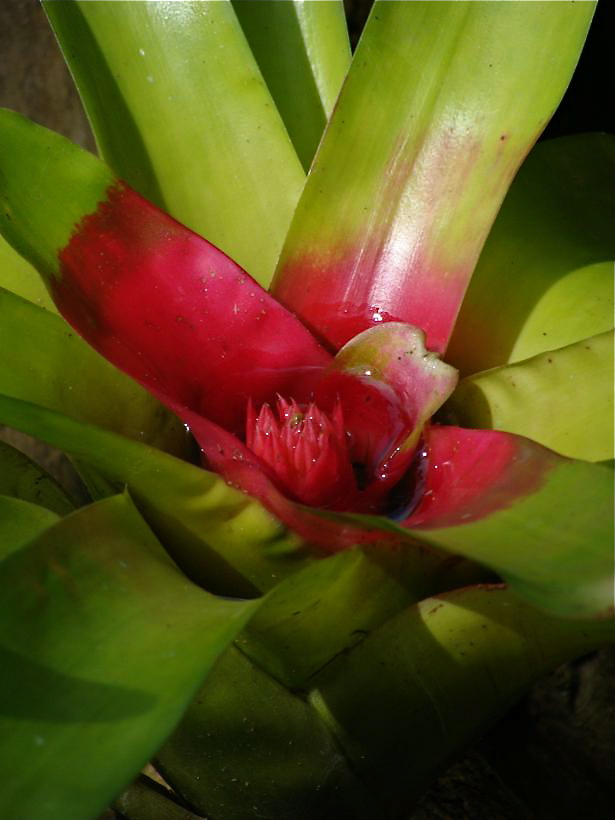
Bromeliads


Through time, I have collected a sizable variety of bromeliads and now, they have all started to propagate! I did not begin taking care of these tropical beauties until recently; in fact I was not even keen about bromeliads in the beginning. But friends would give me one or two and I found them so interesting to maintain and take care of. Now I'm hooked!


The Bromeliad family has a wide range of types, predominantly epiphytic but some terrestrials too, and are endemic in environments as diverse as rainforests to deserts. When Christopher Columbus sailed to the "New World" in the late 1400s, he was given a fruit of a bromeliad plant which he liked so much and found so refreshing; he called it a "pine apple." Now how in the world that fruit be like an apple from a pine tree baffles me too. I guess it goes to show how startlingly "new" the discoveries were then.


There is always an appropriate bromeliad for any landscape design, be it under the sun or in the shade. Just like most plants, given the right environment, they do not require much attention and care, requires no pollination, and flourishes fairly fast.


In the gardens, some of them are mixed alongside other tropical plants but some I also put together in groups where they contrast and highlight each other's inherent beauty.