Life at Kaligátan Farm, a country house-in-progress in a coffee farm in the Malaráyat foothills.
The panorama on the sunrise side: an awesome view of Malarayat
The quiet panorama on the sunrise side of the farm: an awesome view of Mount Malaráyat and the river below the gap.
Showing posts with label bromeliad. Show all posts
10 March 2013
More Bromeliads
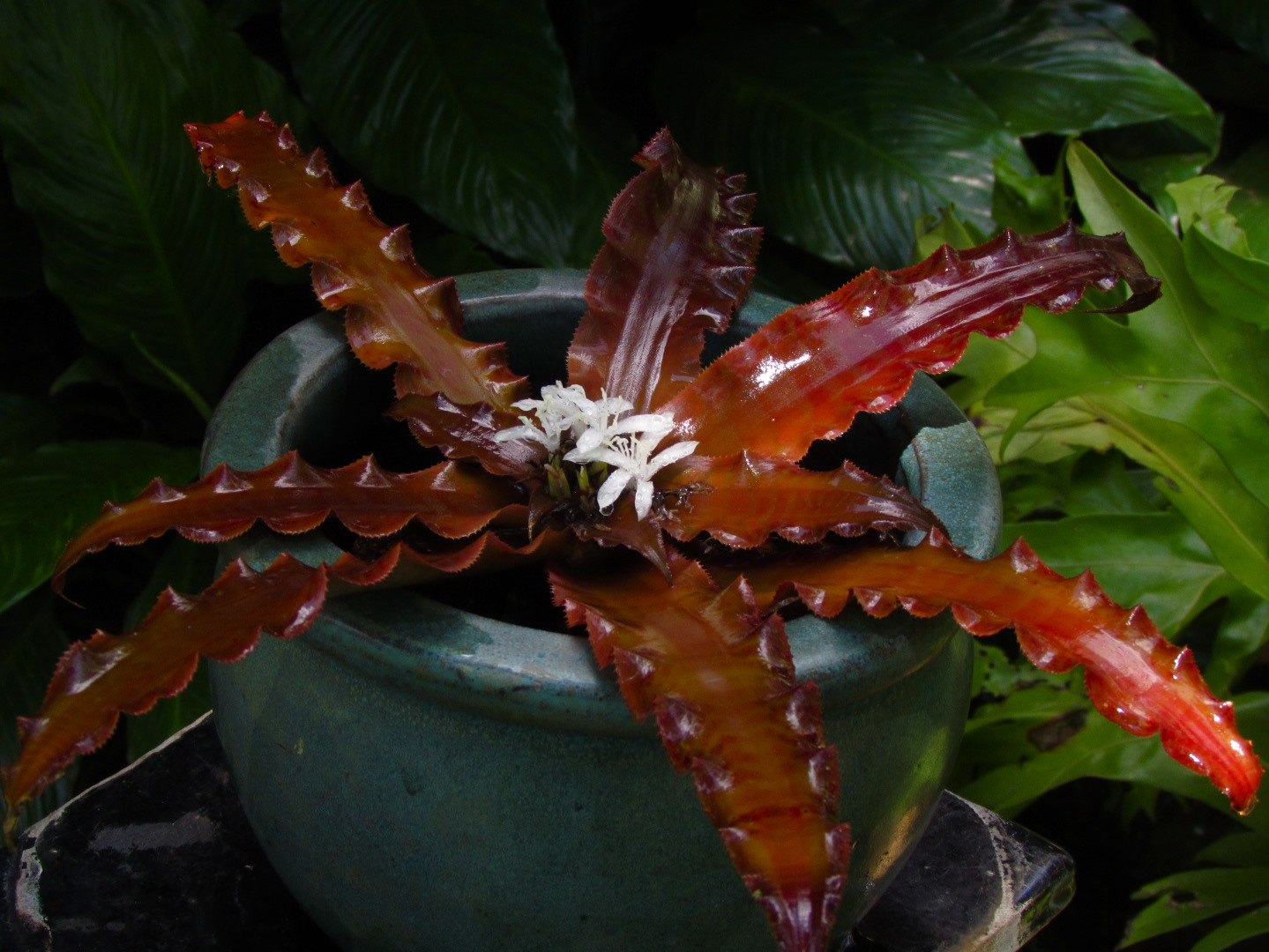
For some weekends now, I have been sorting bromeliads into rows on steel racks I ordered from a neighborhood shop. I didn't realize that we have so much variety already, from Neoregelias (above) to Tillandsias, Cryptanthuses to Ananas (below left).
Some are so prolific in producing suckers; we have one mother plant must have generously given us two dozen! There are some though that baffle me since they only produce one in their lifetime.
17 February 2013
Red
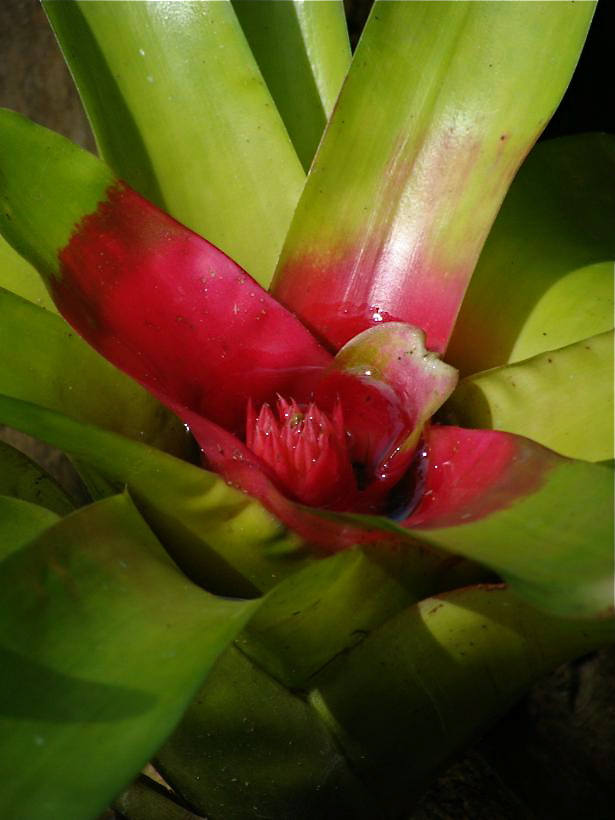
Rather taken for granted, largely due to its profusion are these fairly common bromeliads, a small Neoregelia (above) and a Bilbergia (left). But they're very attractive nevertheless, and it's just a matter of blocking them in a garden to be fully appreciated.
And they're vividly red this Valentine weekend! Red happens to be my favorite color, and I'm partial to anything in this blazing hue. The Neoregelia above blushes at the center when it is fully mature and flowers, while the Bilbergia shoots up a brightly-colored bract before it finally wilts and produces young.
11 November 2012
Earth Star
A beautiful surprise today: first time ever for me to see this bromeliad, Earth Star (Cryptanthus bivittatus) bloom! At first I thought the white flowers fell from a tree or was blown by the wind and landed suprisingly upright. But it turns out this bromeliad has reached full maturity and is now ready to produce offsets.
We've had these Earth Stars for around three years already; I distinctly recall a plant supplier giving it for free after purchasing a substantial number of greens. When we got to the farm, we did not know how to plant it; in fact it took me some time to learn that it is a bromeliad to begin with. In short, we've practically neglected it initially and yet it is a hardy plant and has now even bloomed.
21 October 2011
The Many Shades of Purple
| Spathoglottis plicata |
Purple has many shades and a lot of them are named after flowers: "lilac," "mauve," even "violet" is named after a bloom. But hardly any of the names are from tropical plants, when in fact there is a bigger palette of colors in warm climate flora.
| Pink Quill Bromeliad/Tillandsia cyanea |
The orchid on top is a Spathoglottis species, a low-growing terrestrial that we have begun propagating this year. Just like typical orchids, it had seeds like dust falling off its dried flowers. This one is particularly prolific this year; flowering continuously already for several weeks.
The tiny flower above is of a pink-bract bromeliad from the Tillandsia family. They're best grown potted because of its small size.
The flowering vine below is the infamous garlic vine, pretty to look at but the leaves and the flowers smell like, uh, garlic. At least, they only smell when you pick them, so they're best left high up on a trellis.
A Neoregelia bromeliad (bottom) has mauve-colored leaves when young then changes to stripes with mauve blotches as they mature. This particular one has miniscule flowers, still mauve, in the center of the rosette.
| Garlic Vine/Pachyptera alliacea |
| Neoregelia variety |
19 July 2011
Bromeliads
The Bromeliad family has a wide range of types, predominantly epiphytic but some terrestrials too, and are endemic in environments as diverse as rainforests to deserts. When Christopher Columbus sailed to the "New World" in the late 1400s, he was given a fruit of a bromeliad plant which he liked so much and found so refreshing; he called it a "pine apple." Now how in the world that fruit be like an apple from a pine tree baffles me too. I guess it goes to show how startlingly "new" the discoveries were then.
There is always an appropriate bromeliad for any landscape design, be it under the sun or in the shade. Just like most plants, given the right environment, they do not require much attention and care, requires no pollination, and flourishes fairly fast.
In the gardens, some of them are mixed alongside other tropical plants but some I also put together in groups where they contrast and highlight each other's inherent beauty.
Subscribe to:
Posts (Atom)