The panorama on the sunrise side: an awesome view of Malarayat

The quiet panorama on the sunrise side of the farm: an awesome view of Mount Malaráyat and the river below the gap.
Showing posts with label flowers. Show all posts

11 November 2012

Earth Star


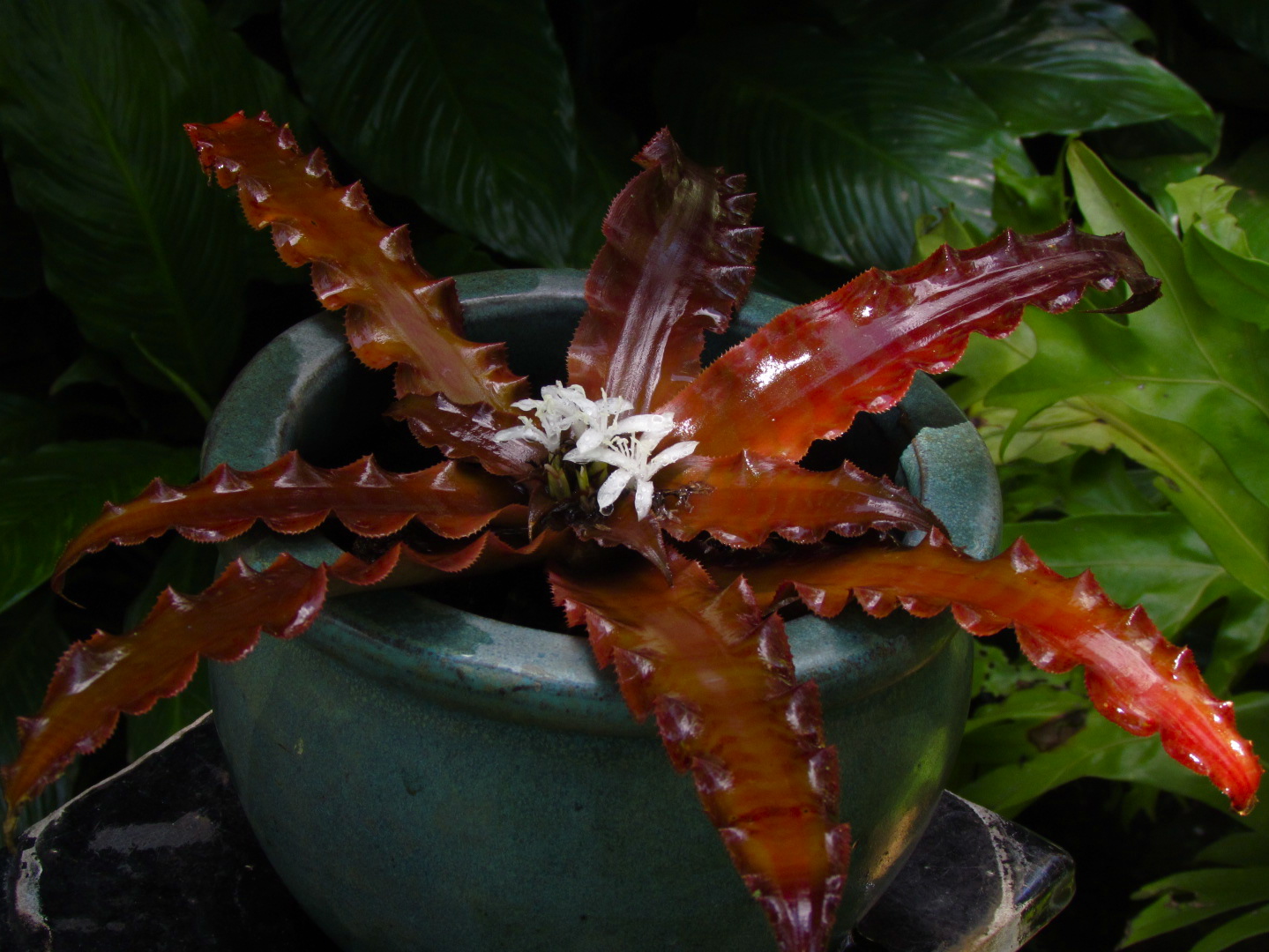
A beautiful surprise today: first time ever for me to see this bromeliad, Earth Star (Cryptanthus bivittatus) bloom! At first I thought the white flowers fell from a tree or was blown by the wind and landed suprisingly upright. But it turns out this bromeliad has reached full maturity and is now ready to produce offsets.

We've had these Earth Stars for around three years already; I distinctly recall a plant supplier giving it for free after purchasing a substantial number of greens. When we got to the farm, we did not know how to plant it; in fact it took me some time to learn that it is a bromeliad to begin with. In short, we've practically neglected it initially and yet it is a hardy plant and has now even bloomed.

10 September 2012

Blue Ginger

On humdrum weekends in the midst of the monsoon season, when it's just about to be almost dragging to consider going back to the city earlier than planned, the gardens will almost always not fail to entice even the most jaded enthusiast with a new discovery. And last weekend was no exception: it can be tiring to sort bromeliads weekend in and weekend out, and you can only be so thrilled by flowering orchids in a season.

But as I walked past the propagation area to check on pots to bring to Manila, an unusual color jumped out of the green-ness of the landscape: a bluish purple that is unlike any other. This is the first time this Blue Ginger (Dichorisandra thyrsiflora) bloomed since we got a specimen from Baguio eighteen months ago. Initially, I was apprehensive it was too hot in my area for it to flower, but to my surprise and delight, a new color is added in our garden :)

14 August 2012

The Most Beautiful Flower in the World


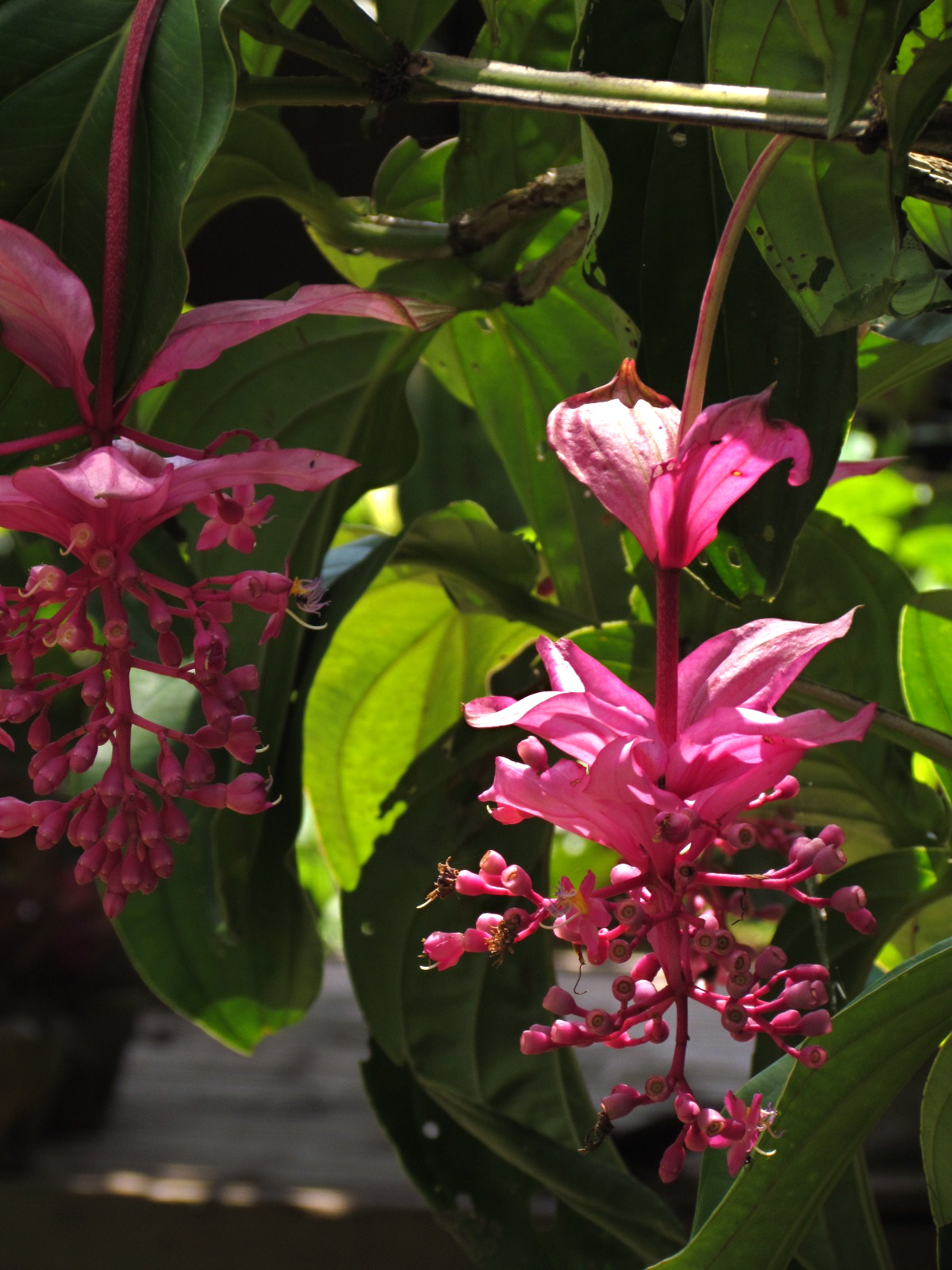
Among the crown jewels of the Philippine rainforest, naturally growing only in our islands, is what is perhaps the most captivating flower in the world: the Medinilla magnifica, locally called Kápa-kápâ. Can you imagine walking in the wild amidst a forestful of trees, vines, small reptiles and animals, and suddenly you are confronted by the elegance and splendor of this astonishing floral gem. It is the stuff legends are made of, like an ostentatious bunch of pendant pink-colored pearls hanging from deep-green, velvet-like leaves.

Two weeks ago, the buds were already beginning to appear (below left), and after a week, the small, undeveloped flowers started to be visible (below right). Actually, the flower on the top photo is not yet mature; it has yet to stretch longer and spread out and produce small, white florets at the end of the beads.


Meantime, we are enchanted witnessing and photographing such a wonder of nature. It belongs to the same family as the rest of the medinillas which are also indigenous to other tropical countries, but this particular kind is the most alluring and is endemic to the country.


11 August 2012

Medinillas

Over time, we have collected quite a substantial variety of medinillas; flowering tropical plants that popularly have pendulous, chandelier-like flowers that weigh down its woody, angular branches. It has rather stiff and leathery leaves, ribbed and pointed, or wavy in some kinds. Some have small (foreground below) or medium-sized leaves (left). The flowers first appear to be pale pink, but later blushes a more intense rose hue or mauvish-blue as it matures.


At first glance, they may look similar to each other but they have distinct differences between each other that merit its own unique taxonomic identity. Their leaves vary, for one, and more importantly, their flowers and its colorations.

One of our recently-flowering varieties is a big-leaf type with a close-up of its bracts that held the flowers (below), which have fallen off by the time this photo was taken.


14 July 2012

White Bird of Paradise

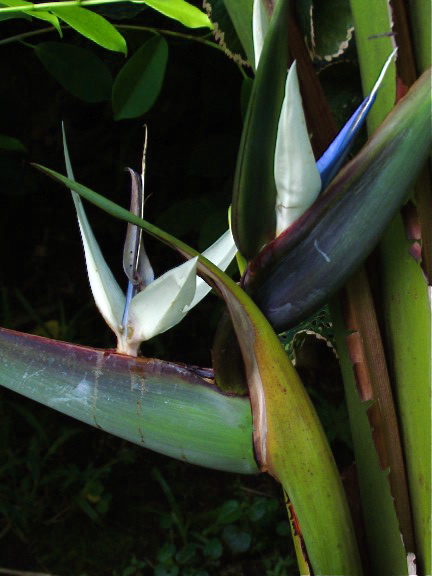
Finally, after a looooong wait, one of the centerpieces in the front lawn has finally flowered! It's such a slow grower that I did not notice the plant has even moved at all. It is the White Bird of Paradise (Strelitzia nicolai), a more exotic version of the more common purple & orange variety. It's only when I compared it to my file photos of the lawn that I realized it was only knee high when we planted it but now, the leaves have gone way higher than the bamboo fence. From what I've researched, it will eventually grow taller and start having suckers until it will be a clump of small trees. Watch out for it around July 2017!

06 July 2012

Rain Lily

One of the pleasant things the wet season brings are the simple yet pretty pink flowers of rain lilies. For much of the year, the narrow, grass-like leaves look just like long, uniform tufts of dark green weeds but once the monsoon starts, they suddenly transform into charming and flawless rose-colored blooms.

14 May 2012

Jacobina

From a single cutting from an uncle's garden more than two years ago, we finally have grown into a flowering bush the strikingly-red Jacobinia plant (Justicia carnea).

It has glossy, deep green veined leaves and vivid red inflorescences (may be other colors in other varieties) that grow in its terminal branches, so periodic pruning is necessary not only for the flowers to grow where you want them to but the plant has a tendency to become too leggy in time. We planted it near the Candle Flower plant (background, Pacystachys lutea) to provide contrast. But to break the continuous green hedges, we inserted a deep-colored Croton in between them (not shown in the photo).

15 April 2012

Flowering Epiphytic Orchids

 It's been more than two years since we've planted epiphytes on the mango trees and this season, two plants whose names I don't even know started to bloom! Nothing beats the immense pleasure of being rewarded with a plant's affirmation that you have taken cared of it well, that it gets itself acclimatized in its new home and starts to flourish and reproduce. Gardening wild plants is tricky and requires a long time, it could never be said enough. But all efforts will pay off once it does thrive, and these two do so very well!


This one on the right, too started to have these minute, pinkish-white blooms this season too. The plant started to adjust quite soon after we planted it but I did not even know that it will start to flower, enchantingly even.


Postscript: I referred the photos to knowledgeable experts via Our Philippine Trees and learned that the orchid on the top and above is called Pinalia polyura while the one on the right is from the Appendicula family. Thanks, Patrick!

09 January 2012

Desert Cassia


A beautiful, small tree that flowers generously is this Desert Cassia (Senna polyphylla), originally from the Caribbean. The slender branches droop when the flowers are in full bloom, weighing them down and lending an elegant air of finesse and poise.


Funny but I came to own this by mistake: there is another yellow flowering tree that I have been looking for, whose name I also did not know then. When I saw this small tree-like shrub with yellow flowers in a garden, I promptly bought this lone stock (apparently, the lady selling also didn't know what it is).


It's grown to be a remarkable specimen, flowering practically all year-round and has produced small legume-like seed pods once. 

31 December 2011

Firespike


Flowering profusely now is the Firespike Plant (Odontonema strictum), looking gorgeously-red this Christmastime. Its flowers which are on its terminal spikes, have a nectar attractive particularly to sunbirds (leftmost part of the bush in the above image) and have been delightfully keeping me occupied photographing them, both the pompous bush and the perky birds.


When i started having this plant propagated, my head gardener Edwin looked baffled, wondering what beauty I find in this plant which they consider more of a roadside weed than an ornamental. But I insisted we grow it and cultivate it as a hedge, and now I'm vindicated :)


19 December 2011

Hoya

Hoya incrassata
Another Philippine jewel from the local rainforests is Hoya, a group of vines and plants from the Asclepias family with small flowers arranged like starbursts and fireworks. Among them is a somewhat popular plant abroad called Shooting Stars (below, Hoya multiflorum, sometimes labeled as Centrostema). Mine came along with some epiphytic ferns and I was delighted to find them one morning, indeed looking like shooting stars. I think they flower all year round, and require practically no maintenance, given that it is planted under the right conditions.


Hoya multiflorum (a.k.a. Centrostema multiflorum)
Ironically, it is more known in other countries than here in its native islands. I myself admittedly did not know about this group of plants until that fortuitous morning I saw it among the ferns. On the other hand, I have come across a zealous native plant collector who has dazzled me with his extensive Hoya collection, with flowers ranging from fuschia to black! So far, I have started sourcing and planting other colors but only the cream-colored flowers are mature enough.


Although it is jewel-like, its name has nothing to do with the Spanish translation for pearl, but instead, named after for an English gardener named Thomas Hoy.


25 November 2011

Contrast


Two plants, totally unrelated but contrast each other in the gardens. Both of them look curiously unusual, and are colored from opposite sides of the spectrum.


Above is the Dwarf Papyrus (Cyperus haspens), a miniature version of the bulky water plant commonly found in ponds or river edges. This looks good as a potted specimen, elevated to a comfortable height so the plant can be appreciated properly.


On the other hand, the Red Powderpuff (below, Calliandra emarginata) has a similar silhouette but is a different plant altogether. In this case, it is the flower and not the leaf that is umbel-like, and is in a bright crimson color that warmly glows in the sunlight.


14 November 2011

From My Library: Flora Mirabilis

I would periodically browse through amazon.com's site and window-shop for good deals, enjoying going through some selected pages as if I'm leafing through real books in a bookstore. I'd put them on my shopping cart after  but won't actually purchase until I'm certain someone can bring it here to the Philippines if I have it mailed to family in California. Sometimes, the deal gets taken and their system will replace it with a pricier equivalent.


For some reason, this National Geographic book is one that's been parked for a long time and never made it to the virtual check-out counter. I've not been to the US for some time, for one. I guess I've also just forgotten about it. But to my sheer excitement, I found a clean and marked-down copy some months back in Book Sale in my neighborhood grocery!


It is sumptuously illustrated, with awesome botanical prints in every single turn! It is a romantic gardener's prized book, with rare and delightful visuals that would fascinate you just as much as the plants themselves. Since I had it, I've been trying to get another copy with the intent of tearing off the pages and framing them as wall decór!


The author, Catherine Herbert Howell selects important historical plants that shaped our present culture and lifestyle today: wheat, rice, sugarcane, tobacco, tomato, cannabis, and orchids, just to name a few. It explains the plants in the context of parallel historical events to help the reader better understand and appreciate just how important and influential plants really are in our daily lives. There are even timelines (below), sidebars with historical notes, striking quotations that would make us see history from a new point of view.


20 September 2011

Garden Bananas


On the other hand, we also grow other banana varieties for landscaping and decorative purposes. All bananas, edible or otherwise, belong to the Musa botanical family, and these (above and below) are no exception. They're maintenance-free and just fluorish on their own. It's very easy to just cut the attractively-colored blossoms and include it in a tropical arrangement.


13 September 2011

Two Flowering Trees


Fragrant trees, now heavy with blooms are Champáca (Michelia alba, above) and Ylang-ýlang (Cananga odorata, below). Both tropical trees are not stunning to look at but compensate by being the most pleasantly-perfumed. Folks traditionally plant these trees near gates or windows for an even more sensory appreciation of a garden or a home.

Champaca belongs to the Magnolia family, and there are several flower color variants. I have always heard of the name but it wasn't until I started in Lipa that I actually learned how it looks and smells.

Meantime, Ylang-ylang is a native tree with drooping branches and leaves, and can grow to four- or even five-storeys high. In my Mandalúyong house, I'm fortunate to have a neighbor with a full-grown tree which scent we can smell until our property. Sometimes, when ours in Lipa have no blooms, we knock on our city neighbor and ask for flowers to scent our interiors.


The ylang-ylang tree and its flowers are not very photogenic and quite hard to capture clearly. Below is a botanical print by Fr Blanco from Flora de Filipinas.

from Wikimedia Commons


18 July 2011

White


Three fragrant flowers, lately in bloom: above left, gardenia (rosál, Gardenia jasminoides); above right, white ginger (cámia, Hedychium coronarium); and below, orange jasmine (kamuníng, Murraya paniculata).


07 July 2011

Yellow

Hibiscus cultivar/Gumamela
Pachystachys lutea/Candle Flower
Beautiful tropical plants in sunny yellow, standing out in the gardens and will give anyone cheer even on the gloomiest days.
 
Oncidium "Dancing Lady"

Sanchezia speciosa
Cassia alata/Acapulco


04 July 2011

Frangipani

Planted around the gardens are trees that produce fragrant flowers, and among the more prominent ones are frangipanis (Plumeria, Tag. kalachúchi) of various colors but all sweetly-smelling nonetheless. The trees have a beautiful free-form, almost sculptural shape, its trunk a textured grey. Gardeners patiently prune the trees even through long periods of time just to achieve the perfect stance.


Ours are still pretty young or were only transplanted a couple of years back, yet they flower profusely and lend a more sensory experience in the gardens.