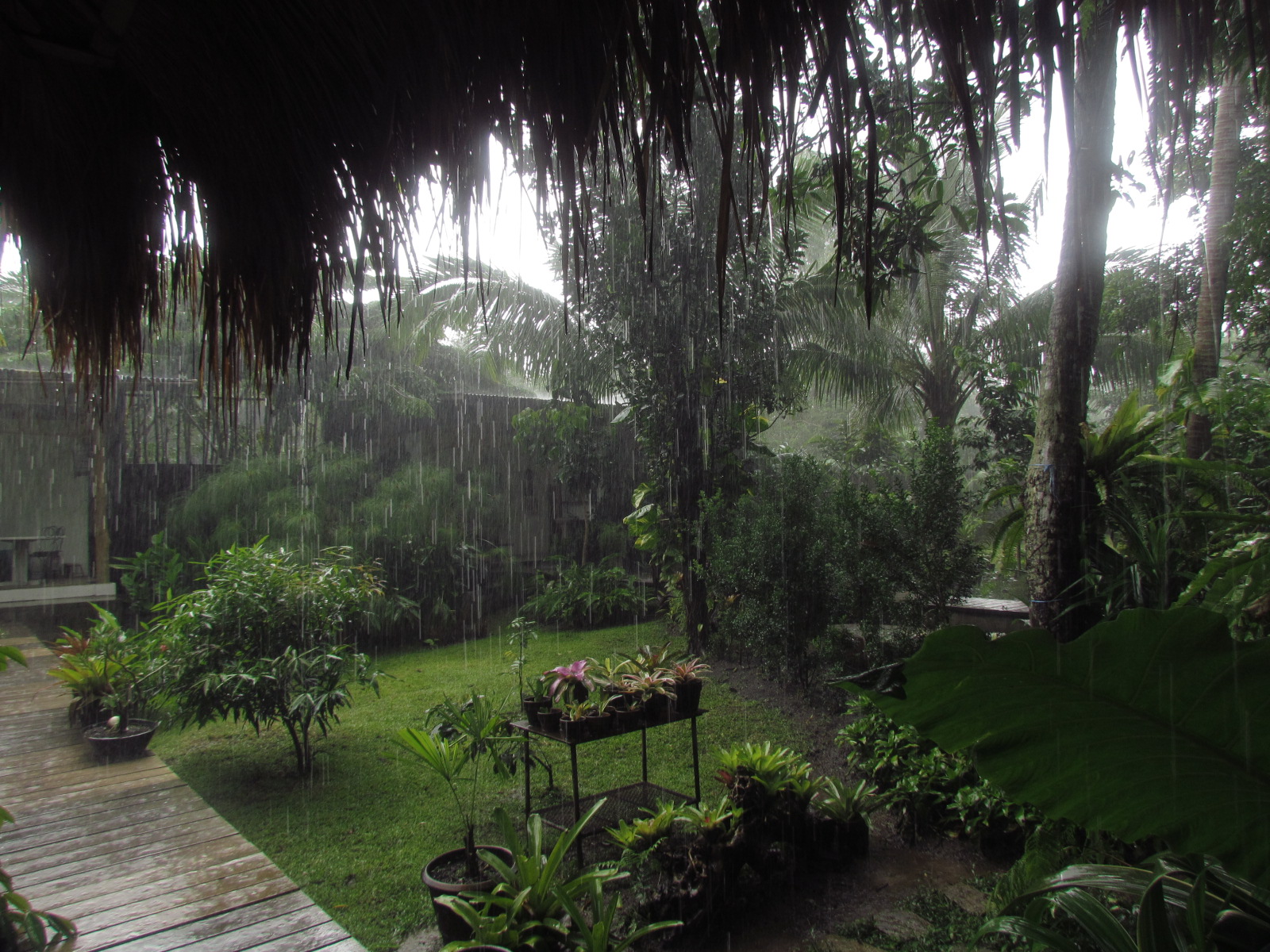
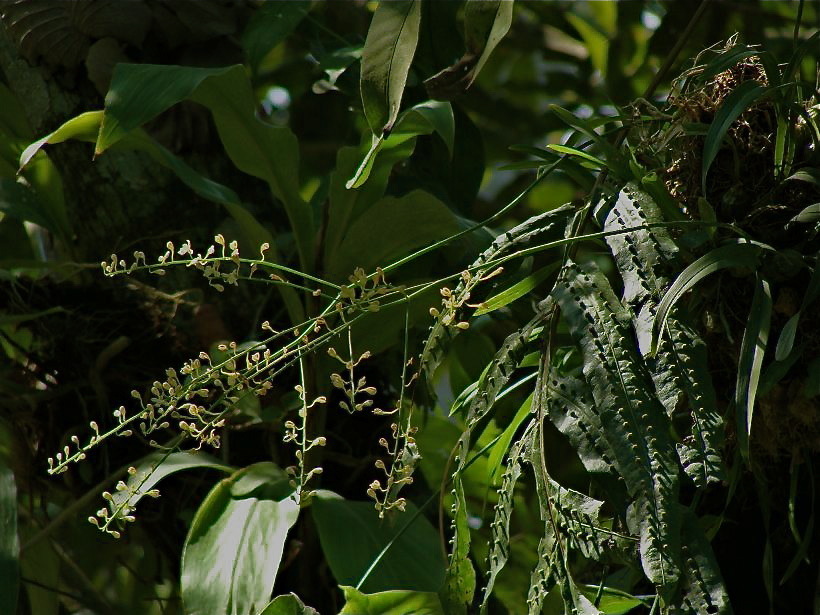
After a long, dry hot season, it's so exciting to see the ferns grow back to life and regain its lushness and beauty. And nothing is more enchanting to see than the amazingly-long Goniophlebium ferns (Goniophlebium subauriculatum), elegantly hanging like long green feathers gently brushing our faces every time we pass by the fern garden.
It's strange though that something as stunningly desirable as this has no common name in either English or Filipino. I've been researching on and off for some years and I have yet to find out how this is commonly known as.
It's been three rainy seasons by now since this transplanted fern has established itself and flourished this much here in its new environment.
Life at Kaligátan Farm, a country house-in-progress in a coffee farm in the Malaráyat foothills.
The panorama on the sunrise side: an awesome view of Malarayat
The quiet panorama on the sunrise side of the farm: an awesome view of Mount Malaráyat and the river below the gap.
Showing posts with label gardens. Show all posts
25 May 2013
11 July 2012
Piedra China
We found a great deal offering one lot of piédra chína, numbering around forty hefty and heavy blocks of dense, raw stone yet naturally polished over hundreds of years. They are of similar sizes but are all uneven; no two pieces are exactly alike. Some are squarish, some have slants. Some have a tinge of pink, while some have longer and shorter sides.
It was both challenging and exhausting to lay them out! I wanted them to look randomly, naturally in place, as if it has always been there, organically part of the landscape. It has a very practical purpose: I needed to connect the entrance driveway through the muláwin gate all the way to the cabáňa with a solid pathway as it always gets either dusty or muddy to walk through.
It was extremely back-breaking to establish a pattern, through trial and error, with stones as heavy as tree trunks! Not only are they uneven (above left and right), I also needed to make the path curve as gracefully and effortlessly as possible.
Their thicknesses also vary widely, so the depths we had to dig to make the finish with an even surface was different for each piece! In the end (below), all the hard labor paid off with a handsomely paved walkway gracing our garden's foyer.
11 January 2012
The Big Picture
Just the other day, I overheard someone say again: "Don't miss the forest for the trees." I have always been predominantly a big-picture person; a lot of times something small is staring up at me right under my nose and I still cannot see it. But strangely, gardening can get me so absorbed and immersed in anything particular, urgent, and detailed. Consequently, a lot of times when I see the gardens, I see problems and gaps and bullet points to write down on my clipboard. It takes quite some effort for me to literally step back enough to appreciate what the gardens have become. This must be destiny's way of balancing my life.
We built the gardens little by little, as organic as possible. It sweeps me off my feet when people find it hard to believe that we've only been around a little over three years and that it was an abandoned, overgrown farm when we started. We let the land and trees tell us what to do. But now, midstream, I periodically forget about this basic tenet especially when I'm too absorbed understanding a bromeliad's habit or why a fern grows one direction and not the way I want it to.
There is no set formula for any garden, as there are just so many variables to consider for one to be, well, almost perfect. There are templates, I agree; but you'll end up like a templated garden which is worse than not having a garden at all. I guess part of the success and more importantly, the fulfillment in garden design is discovering what the land tells you how to go about it and discover the beauty in the natural.
04 November 2011
Aglaonemas
Even as a young boy, I always enjoyed a group of plants that I did not even know the name of but was fascinated by the variety of patterns and hues of its lush foliage. I would bug my Mom to bring to my Lola's house empty pots to have them filled by her gardener Mang Ciano. It was up to him what to put but I would particularly request for these, which he collectively called sédang dáhon (silk leaves). [A footnote: after some months and I failed to keep them healthy, we repeat the cycle of the empty pots and the bugging and the requesting...]
Now that I have my own garden, I started collecting aglaonemas, which turns out to have an even bigger number of varieties and cultivars. They are a member of the aroid family (Araceae) just as alocasias, anthuriums, philodendrons, and xanthosomas. Also, despite them being given the popular English name of Chinese Evergreens, they are actually endemic to the Philippines, particularly to Luzon.
They thrive best in filtered sunlight: too much and the leaves will burn while too little will not bring out the patterns and the colors. I place them under big philodendrons as proportionately-big ground covers and to offset each others' leaf shapes and patterns.
They would also look good as potted specimens and do well as indoor plants. Moreover, most of them have unusually-colored or patterned stems, all the more it is best placed on a tabletop to better appreciate the plant.
16 October 2011
Rain and Shine
It's one of my most favorite times of the year to be in the farm. Although there are hardly any fruits in season at present, the gardens and the plants are at its most gorgeous! The heavy rains are always followed by clear days with heavy dew on early windless mornings. The light the sunrise brings makes nature glow with a warm and calming ambience.
| The haze is not from a filter but instead, moisture on my lens after removing the cap on a cool, damp morning. |
And it's the ferns that relish this weather the most, of all the plants in the gardens. I think it's this time when they are the most prolific, with practically most of the ferns successively bringing forth new crosiers (left), the coiled tips that would eventually unfurl and become the amazingly-diverse variety of fronds (the fern "leaves"). On this photo, it's interesting to see a crosier, a mature frond stalk (the dark brown in the middle) and a young frond stalk (the light green on the right).
| Apparently a Mircosorum variety |
| Microsorum punctatum "Grandiceps" |
| An unidentified variety |
| An Asplenium variety |
22 September 2011
From My Library: Tropical Garden Design
Undoubtedly, many people have preceded him and may have even been better, but it is to his credit that he made it popular, systematic, and recognized in other parts of the world. Many people still call this style Balinese, both the landscaping and the architecture, but it is really a mishmash of many influences that have evolved to the present-day style.
Tropical Garden Design is a good reference book for aesthetic design and the visual side of landscape architecture. The photographs are sumptuous and inspiring, priming your creativity to re-do your garden or buy new pots or just do anything to make you keep up with the remarkable gardens in the book.
18 July 2011
White
Three fragrant flowers, lately in bloom: above left, gardenia (rosál, Gardenia jasminoides); above right, white ginger (cámia, Hedychium coronarium); and below, orange jasmine (kamuníng, Murraya paniculata).
11 July 2011
Heliconias
Heliconias are among the most attractive plants in a tropical garden, and they're so easy to grow! If you have a relatively big space, try planting some of these strikingly colorful varieties. Before I set up 1784, I would stubbornly grow them in pots in Manila which is impractical since they are bulky and need room to grow underground and keep itself upright.
They are not endemic to the Philippines but instead, are originally from the Caribbean, Central and South America. But they easily adapt to our conditions and I don't think they pose any harm to our indigenous environment. On the other hand, they enhance the ambience of any tropical setting.
Quite a number of people mistakenly call these plants (no matter what variety) as Bird of Paradise, which is a totally different plant altogether. In fact, that is more closely related to the Traveler's Palm than anything else. I think what confuses people is because all three of them (like still a big number of plants) produce colorful bracts that hold the true flowers inside (some just the size of pinheads).
They're very useful for simple flower arrangements since they're big and will hold up even by itself with some simple greens. Best of all, they keep long! Just put some water on a vase or a bottle, enough to wet the cut tips and they'll stay nice and colorful for even more than a week.
07 July 2011
04 July 2011
Frangipani
Planted around the gardens are trees that produce fragrant flowers, and among the more prominent ones are frangipanis (Plumeria, Tag. kalachúchi) of various colors but all sweetly-smelling nonetheless. The trees have a beautiful free-form, almost sculptural shape, its trunk a textured grey. Gardeners patiently prune the trees even through long periods of time just to achieve the perfect stance.
Ours are still pretty young or were only transplanted a couple of years back, yet they flower profusely and lend a more sensory experience in the gardens.
25 June 2011
The Fern Garden
| Enchanting lace-like Davalia and Drynaria leaves. |
Perched on the branches are an assortment of aspleniums (dápô), drynaria (pakpak-lawin), platycerium or staghorn (capa de leon), nephrolepis, goniophlebium, and davalia.
It is an enchanting part of the gardens; anyone can't help but be mesmerized by the intricately-leaved ferns of various patterns and sizes. Most of the ferns are endemic to the Philippines and are cultivated by us from our own spores.
Allied with the ferns are other epiphytes that naturally grow alongside them: orchids, hoya vines, gingers, and other tropical wonders.
There are also terrestrial ferns like maidenhairs (culantrillo), angiopteris (pakông kalabaw), and cyathea.
These also grow side by side with alocasias, aglaonemas, philodendrons, caladiums, and dieffenbachias. And on one side of the courtyard is a trellis that hosts one of the jewels of the Philippine rainforest: the jade vine.
Subscribe to:
Posts (Atom)