The panorama on the sunrise side: an awesome view of Malarayat

The quiet panorama on the sunrise side of the farm: an awesome view of Mount Malaráyat and the river below the gap.
Showing posts with label vine. Show all posts

10 April 2012

Vines by the River

Apart from the wild plants and ferns down by the river, there is a substantial number of vines; some even flowering at this time, that add to the biodiversity of our small and fragile micro-ecosystem. I assume these are indigenous to our forests; after all, the area's fairly remote and wild enough to dispel the possibility that they are cultivated and non-native. Some of them yield attractive flowers or fruits that look curiously different and deserve at least, an attempt to promote for them to be identified.


The two on the left have startlingly-unusual forms, and would easily captivate any man-in-the-street. I would imagine too that some of them would be food for some birds and animals.

There is still so much for us to learn about local plants and trees, God bless the few people who tirelessly educate and promote our own endemic flora. I myself have tremendously increased my appreciation of our own plants largely through a blog just like mine, called Our Philippine Trees. It's a rich storehouse of information and has personal stories and photographs from a true advocate. I thoroughly enjoy learning that a lot of the place names in the country are plants that we've never even know are plants and trees int he first place! Does anyone know that Cabuyao is a tree, Bocaue is a type of bamboo, Diliman is a fern, Lucban is a fruit, and even Anilao is not just a diving destination to begin with!

29 March 2012

Jade Vine

Nothing is more alluring than the extraordinary Philippine jewel: the Jade Vine (Strongylodon macrobotrys). Magnificently hanging from its otherwise plain-looking vine are these blue-green and purple flowers that look like chandeliers just like the Lady's Slipper Vine but this rare local plant is far more mesmerizing, if only because of its turquoise hue. In fact,I am now in the midst of designing a new trellis just to showcase its cascading flowers even better.

11 March 2012

Lady's Slipper Vine

A "pair" of Lady's Slippers in detail
Only a few months in a year do I have the pleasure of showering amidst the blooms of the Lady's Slipper Vine (Thunbergia mysorensis), now mesmerizing me as I wash myself after a long day of gardening. The morning sun side of the toilet & shower area is partly open to the elements so oen can easily see the assorted plants we grow outside it. We have trained the vine to climb a wooden trellis bordering the enclosure and now that it's flowering season, they are lined up in different stages of bloom, pendulously hanging like small tropical chandeliers.


02 February 2012

Monstera

A vine I have been taking care of for some time now is the Swiss Cheese Plant (Monstera obliqua). From cuttings I asked from a friend's neighbor, it has taken root and finally crawled up a post after around two years of patient waiting. Rooting it was not that hard (but it did take long); it was the climbing up that seemed like forever.


It grew in length but it wouldn't cling. We tied the length of the vine on the post but it looked like it just had a plan of its own. Training vines on posts and tree trunks turns out to be not as simple as I thought it to be. 


Anyway, it eventually started to have branches at the base which started to cling on its own. It was just a matter of time.


Now, I also finally managed to source a reasonably-priced rooted cutting of the other Monstera vine, M. deliciosa. I'll feature it climbing up a tree maybe around late 2014...

19 December 2011

Hoya

Hoya incrassata
Another Philippine jewel from the local rainforests is Hoya, a group of vines and plants from the Asclepias family with small flowers arranged like starbursts and fireworks. Among them is a somewhat popular plant abroad called Shooting Stars (below, Hoya multiflorum, sometimes labeled as Centrostema). Mine came along with some epiphytic ferns and I was delighted to find them one morning, indeed looking like shooting stars. I think they flower all year round, and require practically no maintenance, given that it is planted under the right conditions.


Hoya multiflorum (a.k.a. Centrostema multiflorum)
Ironically, it is more known in other countries than here in its native islands. I myself admittedly did not know about this group of plants until that fortuitous morning I saw it among the ferns. On the other hand, I have come across a zealous native plant collector who has dazzled me with his extensive Hoya collection, with flowers ranging from fuschia to black! So far, I have started sourcing and planting other colors but only the cream-colored flowers are mature enough.


Although it is jewel-like, its name has nothing to do with the Spanish translation for pearl, but instead, named after for an English gardener named Thomas Hoy.


21 October 2011

The Many Shades of Purple

Spathoglottis plicata

Purple has many shades and a lot of them are named after flowers: "lilac," "mauve," even "violet" is named after a bloom. But hardly any of the names are from tropical plants, when in fact there is a bigger palette of colors in warm climate flora.


Pink Quill Bromeliad/Tillandsia cyanea
This month alone, four plants: a ground orchid (above) two bromeliads (left and bottom) and a flowering vine (below) are making the gardens more mesmerizing with their gentle purple blush. Cool colors are not too common in a tropical garden and they always give an interesting contrast to the warm oranges and bright yellows. In my experience, purple-hued flowers always command a second look, and psychologically calms rather than excites. It is a color that quiets me down, and causes me to be introspective.

The orchid on top is a Spathoglottis species, a low-growing terrestrial that we have begun propagating this year. Just like typical orchids, it had seeds like dust falling off its dried flowers. This one is particularly prolific this year; flowering continuously already for several weeks.


The tiny flower above is of a pink-bract bromeliad from the Tillandsia family. They're best grown potted because of its small size.


The flowering vine below is the infamous garlic vine, pretty to look at but the leaves and the flowers smell like, uh, garlic. At least, they only smell when you pick them, so they're best left high up on a trellis.


A Neoregelia bromeliad (bottom) has mauve-colored leaves when young then changes to stripes with mauve blotches as they mature. This particular one has miniscule flowers, still mauve, in the center of the rosette.


Garlic Vine/Pachyptera alliacea
Neoregelia variety

12 October 2011

Shingle Vines

Another interesting tropical curiosity is from the Rhapidophora family, a vine native to the Philippines yet I don't see it much in gardens here. In fact, I first got acquainted with it in Indonesia (where it's possibly indigenous as well). 

Researching on the web does not yield much information. Some sites and books don't even agree on the everyday name of the more common type (left). I've heard some people call it "Shingle Vine" or "Shingle Plant" but I have yet to see an authoritative source confirm this.

A robust grower, the vine trails vertically without branching out, at least in my experience. I think most aroids behave like this, what books call "self-heading."


The leaves look like they cling to the wall (or to a tree in the wild), but surprisingly, they are not adhered as one initially imagines it to be. They're just uprightly flat and always evenly laid out.

Some months back, I visited the private garden of a native plant collector and I was astounded to see that he has another variety (right) with a beautiful texture and a richer hue. He sold to me a cutting and so far, has vigorously started to grow in my garden.

03 October 2011

The Lipstick Plant


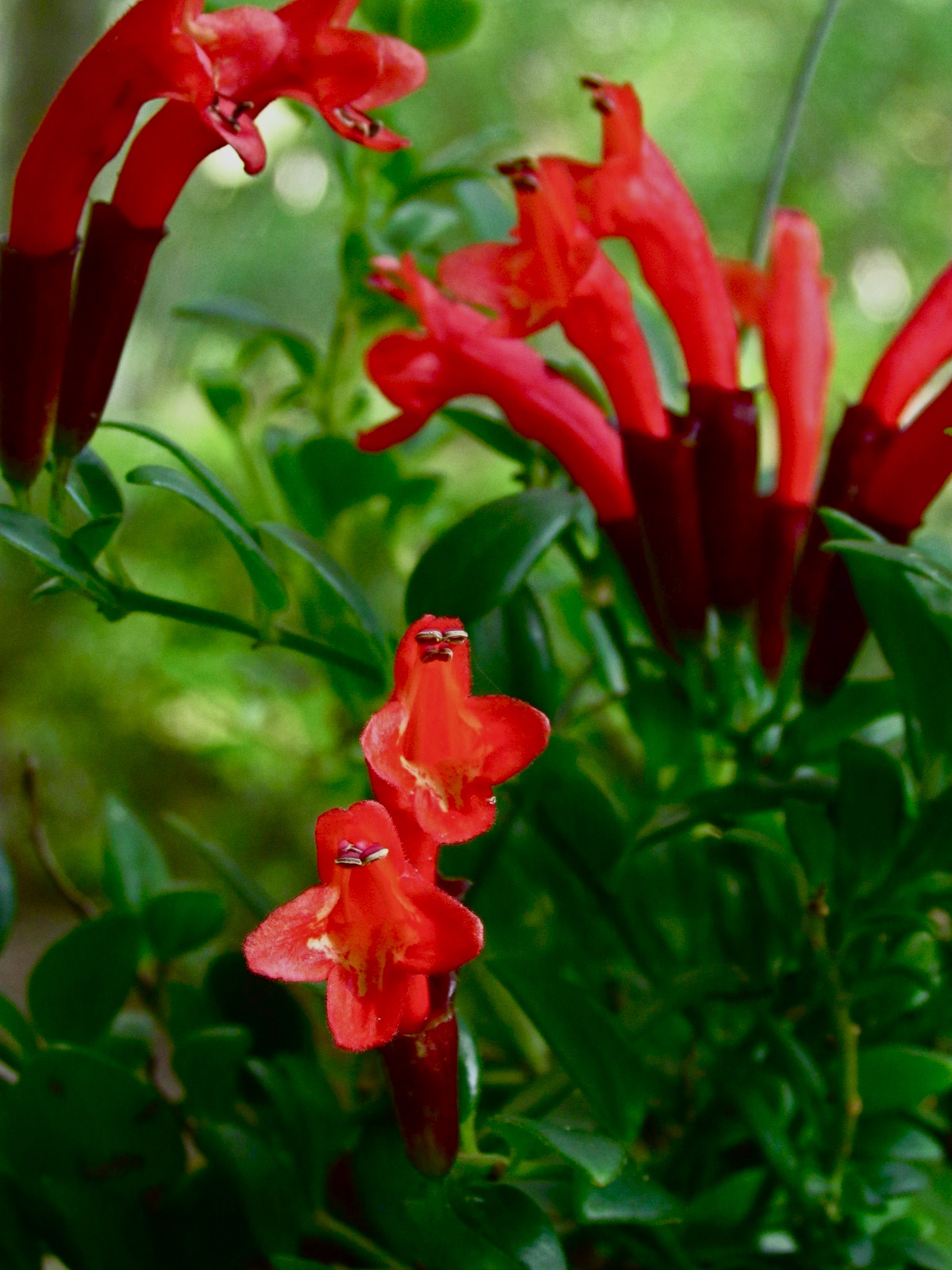
Anyone can't help but notice, even from a distance, the startling red flowers of the Lipstick Plant (Aeschynanthus). A native of the Philippine rainforest, it naturally occurs as a vine in host trees, epiphytic in nature and highly-dependent in the damp tropical climate. In some gardens (like ours), they are hung from a wire basket to let the vines fall off the edge and flamboyantly display the attractive flowers.