The panorama on the sunrise side: an awesome view of Malarayat

The quiet panorama on the sunrise side of the farm: an awesome view of Mount Malaráyat and the river below the gap.
Showing posts with label native. Show all posts

27 July 2013

Philippine Tree of the Month: Rambutan


 I purposely waited to blog about this until now that it is fruiting! The Rambután (Nephelium lappaceum) is a true Southeast Asian native, and grows indigenous in the Philippines especially in the South. Now, it is widely cultivated especially in our Makiling-Malarayat-Banahaw triangle. It is a small tree that looks simple and unassuming until it fruits once the rainy season starts (left) and will turn flaming red come September. It is related to more popular fruits, the lychee and the less known lóngan.
We have mature, fruiting trees already that have been planted even before we procured the farm. We also added three around the gardens largely because of its attractively-red, and intensely tropical-looking fruits.

31 May 2013

Philippine Tree of the Month: Santol

 A beautiful local tree that's part of our everyday life is the common backyard tree, Santól (Sandoricum koetjape). Many people are familiar with this as it is one of the few tropical trees with random leaves that turn red before falling off. Its trunk is usually straight and can be sawed as lumber. In fact, Mang Pilô from whom we bought the farm, asked to cut three trees for lumber to make a new house before turning over the land to us, and a tall and regal santol tree was one of them (the other two were duhat and muláwin).
And who wouldn't know its fruit? I think everyone's grew up with it, peeled and eaten with rock salt, cringing from its slightly acidic taste just to get to the luscious whitish pulp at its core. To this day, it's such a simple pleasure to end a long, weekend lunch with a bowlful of santol, eating candy-like the sweet white pulp around the seeds. I guess it is for this reason some foreigners call this the lolly fruit!

28 April 2013

Philippine Tree of the Month: Katmon

A small yet handsome native is in flower now just outside our kitchen; it is called Katmón (Dillenia philippinensis), another endemic tree, naturally occuring nowhere else in the world but our archipelago. It's awesome to know that our islands host a staggeringly-diverse and unique ecosystem, beginning with trees that so effortlessly grow in our part of the world. These, including the Katmon, play its part in maintaining the balance so important to keep our lives in equilibrium.


In the wild, it is most often seen near rivers and can grow with only partial sun. So it perfectly thrives where we planted it: just by the kitchen under the roof's edge where it gets plenty of rainwater.

Its fruit also happens to be not only edible but delicious! I have yet to photograph it though as it's always eaten by the time I get to the farm. Lucky for me though that this weekend, it has plenty of flowers: white and showy, as big as saucers.

16 March 2013

Philippine Tree of the Month: Anubing

In the middle of the fern garden, amidst a grove of mango trees, is a lone Anubing (Artocarpus ovatus), another endemic tree, which means it only naturally occurs in our islands. Being an Artocarpus, it is closely related to the Antipolo (which I have yet to feature), the Rimas, the Langka (Jackfruit), and the Kamansi. I was absolutely ignorant about its significance when we began here; it's a good thing the locals empathically suggested we keep this as we cleared the overgrowth in the would-be garden. At that time, it was still small (just twice my height, I reckon) and was rather puny since it was in the shaded midst of mature mango trees. But now, it is a towering specimen with a perfectly straight and upright trunk and a full crown of leaves.

And speaking of leaves, one of the Anubing's unique characteristics is its leaf's underside sticks to clothes like Velcro (right)! Apparently, it fruits too but is quite insignificant as it isn't edible. It's also a hardy tree and would thrive in rather difficult circumstances (i.e. lowland thickets, shaded areas), making it a good tree for reforestation.

Being in the middle of the fern garden, we transplanted Pyrossia on its trunk (below) and it has nicely thrived and blended amidst the fernscape.

16 February 2013

Philippine Tree of the Month: Alawihaw


Now emerging taller than our palms is a native dipterocarp called Alawíhaw (sp. Alawíhao?), whose scientific name I have yet to find. I chanced on this seedling only around three years ago, when I did not even know yet the importance of native trees. At the Manila Seedling Bank, I was talking to a staff member, inventorizing through their peripheral stocks I may not yet have. He pointed out this lone seedling, coyly telling me that this is a native tree, sounding rather deprecating yet I perceived he meant it as a practical and prudent choice.

Some months later, I became more aware of the importance of promoting our native flora, and I'm glad my Alawihaw's had a headstart.

20 January 2013

Philippine Tree of the Month: Pili


Towering in the garden in less than five years is a Píli tree (Canarium ovatum), one of the very first seedlings we planted when we started here in San Celestino. I first appreciated this tree on a trip to Bicol, then to Negros Occidental. Apart from its delicious nuts, it is a handsome specimen tree and a sturdy hardwood.

Little did I know then that it is endemic to the Philippines, and comes in several varieties, all naturally occurring only in our country.

16 December 2012

Philippine Tree of the Month: Baguilumbang

When I set out to plant a pair of shade trees for our parking area, I went to great lengths choosing a pair of native trees whose names are heard of but people have hardly seen. I eventually narrowed down my choices to Lumbang (Aleurites moluccana), and went on looking for seedlings. Throughout that time, I got acquainted with a foundation whose advocacy is to promote planting native trees.

The day came I was to pick up my Lumbang seedlings and soon after, we planted it. Some months passed and this foundation invited me to contribute anecdotes to a book they will publish about Philippine Trees. I wrote about Lipa, my city's namesake, and Lumbang whose story I mentioned above.

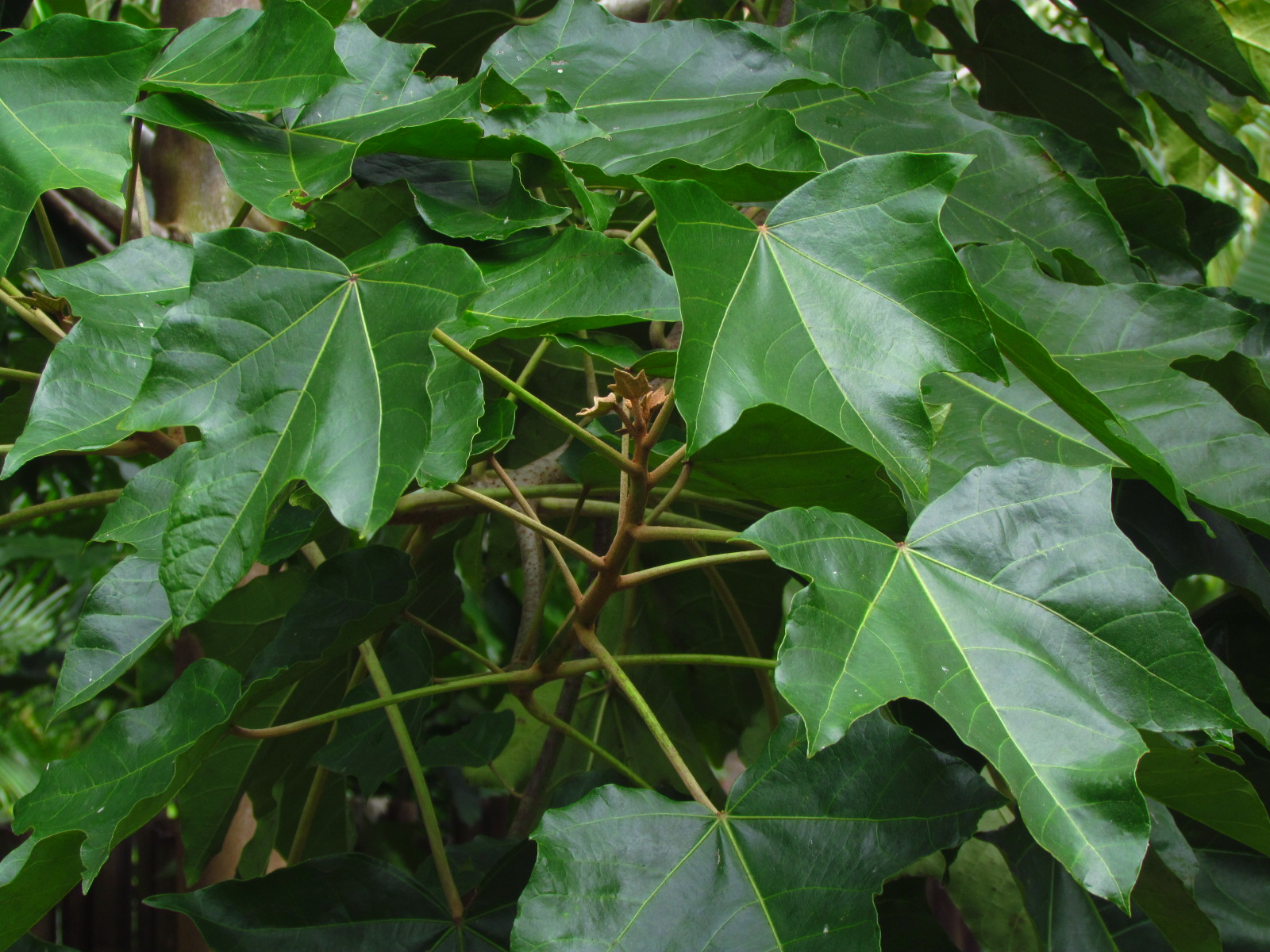
When the book came out and I brought it to the farm, the Lumbang photos (not from my tree) did not look like what we have at all! The leaves are different and the tree's shapes do not look alike. On the same book, I found out that I planted instead a pair of Baguilumbang trees! Now I have not heard of Baguilumbang (Reutalis trisperma), but I learned from the book that this is an endemic tree unlike the Lumbang which occurs in many countries in Asia (which explains why it has an English name, the Candlenut Tree).

I have grown to like the Baguilumbangs: apart from it being such fast-growers, they are actually an endangered species, making it an even more important tree to propagate. More people are even made aware now of a relatively unknown native tree simply by planting them!

13 October 2012

Philippine Tree of the Month: Rimas

One of my most favorite trees is the Rímas (Artocarpus altilis), with enormous foliage and an over-all robust stance that makes it look like it will explode with fruits! I first learned to appreciate it on a visit to the Batanes Islands many years ago where they use rimas instead of banana leaves to serve their country cooking. Apart from the leaves being big, it has a distinct shape and is handsomely veined.

It belongs to the same family as Kamansî (A. camansi), Langkâ (A. heterophyllus), Márang (A. odoratissimus), and the Tipólo (A. blancoi). It took me time to find a seedling years ago; for some strange reason, no one propagates this and hardly will you find the fruit sold in markets. Now I happened to tell a friend, Tintin about it and she promptly had some sent from her home province in Nueva Vizcaya! She says the fruits just fall off the tree and the seeds germinate by istelf.

Some scientists contest though that the Kamansi is just the same as the Rimas, except that it has no seeds. Either way, both are edible and is in fact, deliciously prepared by cooking in gatâ (coconut cream) garnished with pork or shrimp bits.


It is indigenous to the archipelago but also naturally occurs elsewhere. In fact, it is more closely identified with the Pacific Islands, and is always mentioned as the fruit that Captain Bligh made the trip for on the HMS Bounty, wherein his crew staged the novel-inspiring mutiny.

29 September 2012

The Lipa Tree

Not many people know that Lipâ is named after a tree! Indigenous to the Philippines (that is, growing naturally here in our islands but can also be found in the wild in other countries) and I guess, growing profusely more in our area than in other locations nationwide, Lipa follows a long, pre-Hispanic Malay tradition of naming places after native plants that flourish in that locale. It is highly probable that Lipa grows wild, at least in the greater area that surrounds Taal Lake, since it is widely accepted but little known that the city originally began in the lakeshore of Taal, below what is now known as Mataas na Kahoy. But that's another story altogether...

Though it sounds romantic to learn about the origin of the city's name, most people including locals, have no love lost for this rather notorious tree. In English, it is called the Stinging Nettle Tree, belonging to a family of plants; some trees while others are shrubs, that releases a poisonous fluid when one comes into contact with the leaf's underside. It has small, fine hairs that will stick to one's skin and will start to make you itch and eventually lead to rashes and irritation that can last for several days!

Lipa is one of two Philippine Trees that I wrote about when I contributed articles to the recently-launched book Philippine Native Trees 101, which aims to inform people about the  richness and variety of our local flora, including unusual specimens like the infamous Lipa.


15 September 2012

Saturday Tree Planting

We just finished planting our Toóg seedlings (pronounced to-OG, Petersianthus quadrialatus, Philippine Rosewood) this morning, in the hope that they will grow to be tall and proud specimens of native majesty.

When I first learned about this endemic tree almost a year ago, I happened to discuss it over lunch with my staff. May (left), who comes from Leyte, says these trees grow within their area and she can easily send for some seedlings by bus. So one day, we went to the bus terminal in Manila, anticipating one small seedling but instead, we excitedly received eleven! She laments though, that she doesn't know anyone in their area who gives importance to this tree. In the book Philippine Native Trees 101, it says that wild Toogs have drastically depleted in the last decades because of high demand for its timber.

Today, we planted six of them on the edge of the gap, as a windbreaker and more importantly, to keep the soil firm.  In time, they will also start producing fruits that will hopefully provide food for wildlife.


07 September 2012

Philippine Tree of the Month: Piris

Since the book launch of Philippine Native Tress 101, I've become conscious learning more about native trees in the farm. My staff have been extra generous in keeping me informed and one tree that I absolutely did not even mind nor notice before is what they call "Píris" (apparently, Garcinia vidalii), coincidentally flowering and fruiting now at this time of the year. It's a medium-sized tree that wildly flourishes in the cliffside, going down the river. Our staff, Díko gamely grabbed some fresh young leaves that richly smelled of citronella!

Apart from this tall specimen (left), there are scattered around young trees that are still in the flowering stage (below).


But more exciting are the mature seeds that are easily visible even from afar! The local birds are feasting on them day in and day out, presumably since local trees' fruits are the preferred avian diet of our native birds. In the next days, we'll figure a way to collect the fruits so we can germinate them and hopefully help build better awareness and availability of our beautiful native trees.


19 August 2012

Philippine Tree of the Month: Niog-niogan

Occurring naturally only in our archipelago is Ficus pseudopalma, a small but attractive tree that's quite under-rated, even taken for granted but acclaimed internationally and known as the Philippine Fig.

Here in Batangas, it is called Niog-niogan (literally "pretending to be a coconut," possibly that is why the scientific name is "a fig pretending to be a palm") not only because of how the tree grows but moreso because its fruits indeed, look like small coconuts.

This is the same tree that the Bicolanos call Lubi-lubi; they harvest the young leaves and cook it in gata (coconut cream), a vegetarian stew that must be nutritious and I bet, delicious.


14 August 2012

The Most Beautiful Flower in the World


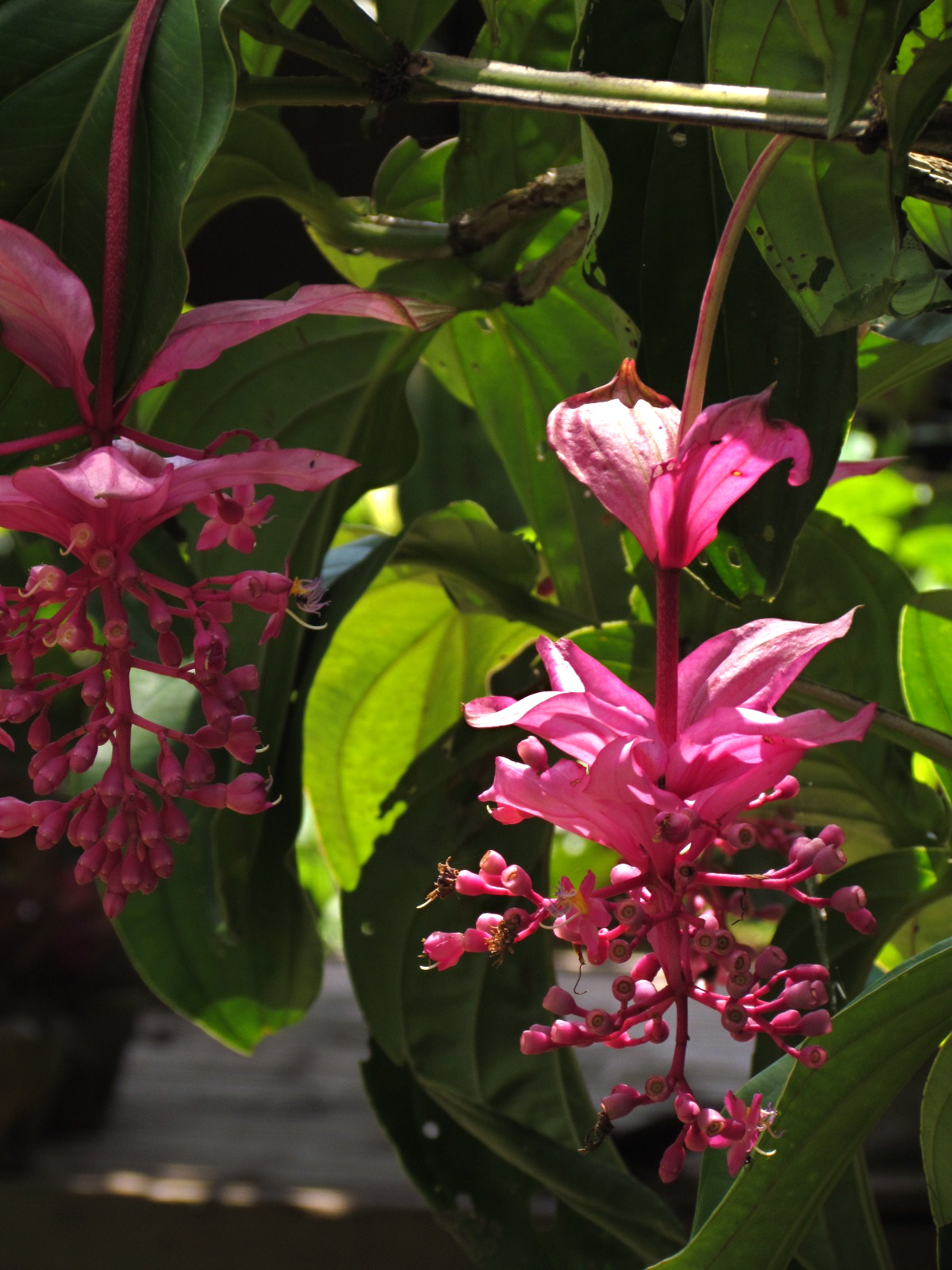
Among the crown jewels of the Philippine rainforest, naturally growing only in our islands, is what is perhaps the most captivating flower in the world: the Medinilla magnifica, locally called Kápa-kápâ. Can you imagine walking in the wild amidst a forestful of trees, vines, small reptiles and animals, and suddenly you are confronted by the elegance and splendor of this astonishing floral gem. It is the stuff legends are made of, like an ostentatious bunch of pendant pink-colored pearls hanging from deep-green, velvet-like leaves.

Two weeks ago, the buds were already beginning to appear (below left), and after a week, the small, undeveloped flowers started to be visible (below right). Actually, the flower on the top photo is not yet mature; it has yet to stretch longer and spread out and produce small, white florets at the end of the beads.


Meantime, we are enchanted witnessing and photographing such a wonder of nature. It belongs to the same family as the rest of the medinillas which are also indigenous to other tropical countries, but this particular kind is the most alluring and is endemic to the country.


02 August 2012

The Return of the Native

There is now a landmark resource book, striking that there has never been a publication, that writes and informs about and advocates planting Philippine Trees! It is not some drab academic material but in fact, an engaging read with evocative stories, accurate and beautiful photography, reliable scientific and practical information, so much that I completed reading it in just one day. It's a valuable storehouse of our natural heritage that each Filipino must have access to. Our local trees and plants make up so much of our identity yet, I bet any man in the street will not even be able to correctly name three local trees in the first place. And to think we have more than 3,600! Even more crucial, 67% of that is endemic, occurring naturally nowhere else in the world but the Philippine Islands.


It's also timely because a lot of good-natured groups and individuals who venture into greening efforts and reforestation are actually planting trees that hardly contribute to our local eco-system. Local tree advocate and blogger Patrick Gozon's story, The Silent Forest is a great read for a start.

I'm fortunate to have been invited to contribute articles and photographs; I wrote about Lipá (yes, it's a tree!) and Lumbang (right), which is the pair of trees I planted in the parking area outside the farm.

10 April 2012

Vines by the River

Apart from the wild plants and ferns down by the river, there is a substantial number of vines; some even flowering at this time, that add to the biodiversity of our small and fragile micro-ecosystem. I assume these are indigenous to our forests; after all, the area's fairly remote and wild enough to dispel the possibility that they are cultivated and non-native. Some of them yield attractive flowers or fruits that look curiously different and deserve at least, an attempt to promote for them to be identified.


The two on the left have startlingly-unusual forms, and would easily captivate any man-in-the-street. I would imagine too that some of them would be food for some birds and animals.

There is still so much for us to learn about local plants and trees, God bless the few people who tirelessly educate and promote our own endemic flora. I myself have tremendously increased my appreciation of our own plants largely through a blog just like mine, called Our Philippine Trees. It's a rich storehouse of information and has personal stories and photographs from a true advocate. I thoroughly enjoy learning that a lot of the place names in the country are plants that we've never even know are plants and trees int he first place! Does anyone know that Cabuyao is a tree, Bocaue is a type of bamboo, Diliman is a fern, Lucban is a fruit, and even Anilao is not just a diving destination to begin with!

18 December 2011

Bagawak


One beautiful plant about to flower now is a true Philippine native, the Bagáwak (Clerodendrum quadriloculare). It has green leaves on the top side but deep purple underneath, with attractive pink and purple flowers that start to emerge at this time of the year. Strangely, it is not common to find these in local gardens despite the fact that it should grow and flower here easily. 


December 2009
 If you leave it untended, it will naturally assume the shape of a small tree. However, from our pilot specimen that produced a multitude of seedlings, we gathered some and clustered them altogether, trying out its ornamental viability as a hedge or a screen. So far, it has taken root but I have yet to see how it will eventually look like, though I imagine it will have to be big and tall, owing to its thick stems and large leaves. It is also only when it is elevated that you will appreciate the leaves' purple underside. 


The experimental hedge will still take some months to define its shape, but in the meantime I am posting photos here of previous seasons' flowers for you to see how uniquely beautiful the flowers are.


January 2010