The panorama on the sunrise side: an awesome view of Malarayat

The quiet panorama on the sunrise side of the farm: an awesome view of Mount Malaráyat and the river below the gap.
Showing posts with label furniture. Show all posts

14 April 2013

Another Bench


We recently bought another garden bench, complementing the older one with the back and armrests, though we did not necessarily lay them out side-by-side.  It's made of exactly the same wood, apparently Dungon (Tarrietia sylvatica), a hardwood that resists rotting so it is suited perfectly for outdoor use. The wood is very tasty though to a particular wood-eating grub (right) that is responsible for the random yet artistic surface design once you cut the old wood up into planks.

08 December 2012

The Glamping Tent


For some years, I've been toying with the idea of a furnished camping tent; I had no clue there is actually a term for it and it has become quite a craze in Europe in the recent years! Glamour camping, or "glamping," for short, is like a more comfortable, stylish, and relaxing version of roughing it out in the

wild. Now a friend gave me this oversized, seven-man tent when we started the farm and I furnished it with our own home-made bamboo furniture.

20 November 2012

Eggs on the Aparador


The free-range chickens are so free that one decided to lay eggs on a glazed bonsai pot, on an antique aparadór in the cabana! This is one of the "concerns" of having open huts; open to the "elements" include not just the sun and rain but even domestic animals like dogs and chickens, and small reptiles.

It would be great though if she lays her eggs in the kitchen already!

09 October 2012

Garden Bench

We have a new "old" bench, a rustic artisanal piece that suits our countryside ambience. It's charmingly simple; a free-form, organic-looking, simplistically-crafted bench, apparently made of Dúngon wood (Heritiera sylvatica). What makes it novel is that the wood's been bored by woodworms, resulting in a random, natural pattern that makes each piece unique. In reality, the timber's practically useless already since its been gnawed at, but some intrepid craftsmen saw the lumber nevertheless and create artistic pieces. 

When I acquired it, it had a somewhat sloppy coat of varnish which I'm letting fade and will hopefully be gone in the next twelve months. This same wood, in its whole but gnawed form, is sometimes used by landscapers to mount bromeliads and orchids on.


01 September 2012

DIY Pandan

I have inherited a peculiar habit from my Mom: we glefully rub our bare feet against a variety of textures, from split bamboo floors to high thread count sheets! Now have any of you discovered the immense pleasure from these pandán pillows and ottomans? They are such handy pieces to have around the house, multi-tasking as side tables, step-stools, caddies for trays, but most sensory as an ottoman to prop your tired feet up. In our case, it serves best as an elevated, three-dimensional organic mat to rub our soles and enjoy the smooth, natural and woven texture.

It's no surprise that I have massively frayed them, especially the corners of the cube-shaped one (right), pandan being a natural and biodegradable material. And wait, while we're at this photo, not many people know that the interior is stuffed with even more pandan leaves!


Anyway, a new piece would have the corners looking even with the rest of the sides (below left). So my trusted staff, May got some fresh leaves from our pandán plant, took off the spines on the edges, air-dried them, and cut them to strips and started weaving our still-greenish leaves into the corners (below right).


She'll let the strips dry in the weave to make it more taut and trim off the edges and lock the ends in place. In just a few days, it will look just as it used to be.


09 July 2012

Filipino Country Furnishings


The Philippines has a rich history of furniture, however it is hardly or loosely curated as in other cultures. I have yet to hear a local (Filipino) term that would classify  country furniture into an equivalent of "Shaker" in the United States or "Provençal" in France.

We have a wealth of artisanal pieces that have survived to this day, despite the fact that country furniture are extensively used and abused, left to the elements even. You don't have to go very far: a lot of times, they are the familiar pieces we have grown up with yet we do not see them as the next stylish piece for the weekend house! I have been scouring around for many years, collecting and streamlining as I go along. Way before we acquired the farm, I gravitated already towards more rustic pieces; with simple lines, hardly any ornamentation, spartan hardware, weathered edges, and a whole lot of character. I don't have much, but what I have all looks and works harmoniously together.

One of the very first things I moved years ago is a very straightforward mésa altár (top), rather uneventful in the Manila house but looked very appropriate in the cabáňa. A wooden batyâ (basin), a brass kawáli (wok), and a burnáy (Ilócos earthenware) jar complete the rustic tableau. The batya is now hung in the kitchen (where it really should be anyway), the kawali we use to burn incense to fumigate the huts, and the burnay always receives brightly colored heliconias or whatever flowers are in season.

Also looking odd in a bedroom in Manila then was this armário (above left), which I recall contained some books on one level and a boom box and some CDs on another. But now, it serves its original purpose as a pillow rack (and baníg [sleeping mats] in the olden days).

Old kitchen implements like these two mortars (below, left and right) serve as accent pieces around our place. A stone almirés gives visual contrast to white sampaguíta and kalachúchi, and a beaten lusóng (wooden mortar) which I just found among my neighbor's junk and asked for is now re-purposed as a bromeliad pot. I'm even on the lookout for more labangán (trough, bottom), in case you have a lólo or lóla who took care of pigs!


12 April 2012

Butaca


Any group who arrives will have someone seated in this planter's chair in the first five minutes. Not only is the shape inviting everyone to lounge, but the texture and airiness of the solíhiya (rattan cane weaving) beckons anyone to relax and unwind with some búco juice to boot!

It is actually a contemporary piece; something that I had customized some years back when the cabaňa was new. It is made of mulawin (also known as molave, a local tropical hardwood) that resists rotting even if exposed to the elements. I had the dimensions slightly exaggerated to make it roomier, so it feels more like a day bed than a chaise longue.


03 November 2011

Around Lipa: Casa de Segunda


Lipa is one of the few Philippine cities (and towns) whose main street is not called Rizal. Instead, it is named after Claro Recto, a nationalist and one of the city's most distinguished sons. The other major thoroughfares pay tribute to equally-prominent Lipéňos: Morada, Luz, Kalaw.

But there is a Rizal Street, a side street of Recto Avenue, some blocks behind the Cathedral. There is a special, sentimental reason for this rather unusual street-naming: the young Jose used to visit a house on this street, a house that you can visit until today. He would arrive on horseback (presumably from Calambâ), tie his horse on the alagáo tree by the gate (which is still there today) to court a young girl he was infatuated with: Segúnda Katigbâk.


The house is a fine example of colonial tropical architecture; it dates from 1880 and is in excellent shape to this day, one of the city's five remaining Spanish-era houses that survived World War II, earthquakes, and typhoons. In fact, this particular ancestral house has this wonderful, lived-in ambience: Segunda's descendants live within the compound and personally attend to every guest who knocks in their gate.


The nárra floors are polished, the capíz windows are complete, the planters and pedestals are filled with greens, and the compound seems to be always abuzz with activity. Once I was there, the barangáy was having a meeting in the courtyard.

Apart from its great condition, it also displays a tasteful selection of period furniture made of tropical hardwoods with exquisite inlays and tracery, rattan caning, Chinese porcelain, silverware and kitchen implements true to the era of this beautiful home. There are family photos, leather-bound books, Lipa memorabilia, and of course, references to Segunda and her famous suitor. But the ancestral house speaks far more than this short historical footnote: its design alone is a good model for tropical architecture.

Despite the heat and the sunshine outside, it was pleasantly cool and breezy within the rooms, the corridors, and especially in the foyer downstairs. Of course, the compound is sheltered by old trees that further enhances the shady and balmy atmosphere.


Casa de Segunda requests a token amount of twenty pesos to help maintain their house. They are open everyday but big groups best book ahead.


25 August 2011

The "Coffee" Table


One heirloom piece that I am taking care of in behalf of my family is a handsome dining table made of nárra, a reddish tropical hardwood with understated, consistently-patterned grains. Most likely, my paternal grandparents must have purchased this early in their marriage in the mid-1920s; family lore says all their children, including my Dad, were born on this table as my lóla was far more comfortable delivering at home without fear her babies will get mixed up with other newborns in a hospital.


It also must have been a contemporary piece then; it is ingeniously designed to extend by simply lifting the top and pulling segmented sections on each end. Moreover, it is in a purely Art Déco style that was so popular in the Philippines and around the world during that time.


Now, I've had many meals on this table, both in my lola's house and much later, in our home where it was kept. But it was not until I brought it to Lipa that I discovered it has finely-sculpted relief work on the end supports. Secretly, I thanked my grandparents for their good taste, selecting a handsome, practical table with a leaf design that looks timeless, unpretentious, and fairly masculine. After all, they could've been swayed by some furniture salesman with hackneyed themes like fleur-de-lis or lyres or worse, festooned garlands and ribbons!
But what really floored me was when I asked one of my staff to determine what leaves these might be. Without batting an eyelash, she (sort of sarcastically) exclaims: "eh di dahon ng kape! Ayán ô, may búnga pà" (what else but coffee leaves! Look, it even has [coffee] cherries).

Holy cow, coffee leaves!? How did I not realize that all along? How did I not SEE that all these years?!? Evidently, they are robusta, liberica, and excelsa, the very three varieties we have in 1784!

Clearly, this is Providence. How else can anyone explain this? It sparked my interest to research more about my grandparents' purchases. I know for a fact that the bulk of his furniture were clearly from the House of Púyat, who were then perhaps the best (maybe even the only legitimate) fine furniture brand available (to my generation, they are the same brand who had the AMF license to make bowling lanes and billiard tables of Coronado fame). Undoubtedly, the style and the workmanship could not have been sourced elsewhere but from them. Besides, my grandfather used to live in cálle Rodriguez Arias in San Miguél, Manila, on the same street where Púyat's workshop/factory was.

But why the coffee leaves? 
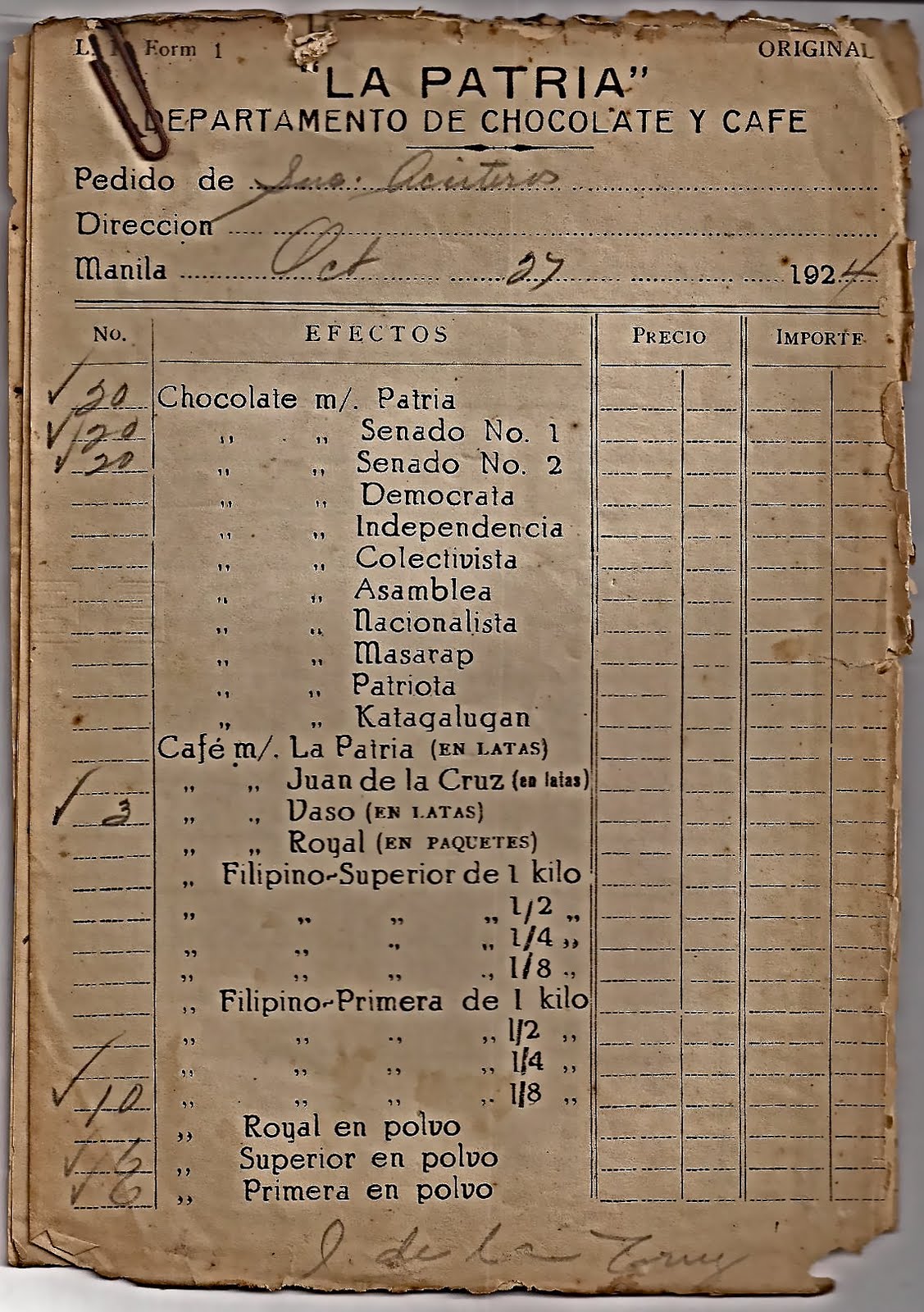
A 1924 invoice from my grandfather's coffee (and chocolate) trading company, signed "I de la Cruz," who was to be his wife, my grandmother, the succeeding year. 


A little-known fact, even among my family, is that prior to my grandfather's long-term and successful bakery business, he first tried his hand in coffee and cocoa production and trading. In the 1936-1937 edition of "Who's Who in the Philippines," my grandfather was written up as "was sucessively engaged in printing, chocolate and coffee factory, bakery. In the grocery business since 1920."

The dining table must be bespoke, what else could it be? Perhaps when it was time for my grandfather to marry, move out of San Miguél and build his cálle Legarda house, he most likely asked his industrialist neighbor Don Gonzálo to organize for him his furniture. I would not be surprised if the process of selecting the monogrammed bedroom suite, the elegant aparadórs (one is in 1784 as well), and the sála set were perhaps delegated to a subordinate to streamline options for my grandfather to choose from. But for his dining table, the gentleman furniture maker personally chose the ornamentation appropriate for his young coffee-trading client.

They had no clue that some ninety years later, such a mundane decision of theirs would quietly affirm an uncertain grandson's ambivalent path to coffee farming.

Thanks, Lôlo (how I wish you were around to teach me now).