The panorama on the sunrise side: an awesome view of Malarayat

The quiet panorama on the sunrise side of the farm: an awesome view of Mount Malaráyat and the river below the gap.
Showing posts with label birds. Show all posts

13 April 2012

From My Library: For the Birds

Now it never occured to me I will ever come across a recipe book to make avian dishes! Gee, the titles one can find in the good old US of A... but, I'm not complaining. A lot of it actually make sense to me but I still cannot help but be amused and find quite preposterous to make a book out of it. I guess the mere fact that I purchased one makes me just as eccentric (and admittedly gullible), hahaha.


Anyway,I will lap up anything that will help increase my bird traffic. The heck, I'll try anything once! Although the birds featured here are North American, a lot of the recipes and its "ingredients" can be transposed to a local tropical setting for our own native species. Now I'll keep this short as I still have to go to the grocery :)


03 April 2012

April Bird of the Month

On the hollow bamboo beams of the cabaňa, hatchlings of a Maya (Eurasian Tree Sparrow, right) are waiting for their mother to bring them their morning meal. The natural anáhaw and cógon roofs actually host a fairly big number of residents apart from us, foremost of which are birds followed by lizards. The cool, organic material mimics natural avian environments which attract them to lay eggs in and rear their young until they're ready to fly.


Mayas are common in the entire country (as far as I know) and are sometimes taken for granted, largely because of their profusion. But they have their own inate beauty and of course, add to the diversity of both bird and plant life in our surroundings.

03 March 2012

March Bird of the Month

One of my most favorite birds is the majestic Láwin (Brahminy Kite), still a fairly visible raptor pretty much lording the skies all over the archipelago. I guess it requires a big area of land and forest to thrive as they are more often visible in the bigger islands like Luzón. In our area in the Malaráyat foothills, it flies high up in the air with its wide and distinct wingspan clearly visible from below, surveying the land below with its keen eyesight (thus, we allude in Tagálog with the metaphor matang láwin).


On some clear days, we can all the more distinguish it because of its distinct chocolate brown feathers. More often than not, it is a solitary bird and is most active in the mid-mornings.

Photographed at the Wildlife Rescue Center, Quezon City

06 February 2012

February Bird of the Month


A pair of Spotted Buttonquails, one male and one female, locally called Púgong-Gúbat. Out on the fields, you will easily spot these low-flying ground dwellers flying off when they hear you walking up to where they are. This pair was injured so we nursed them back to health before releasing them back in the open field.

06 January 2012

January Bird of the Month


The Olive-Backed Sunbird (Pipit, in my area also known as Pusit) has been easy to photograph lately, since they've been enjoying the nectar from the Firespike bushes the last weeks. Otherwise, these perky birds flit from one coconut treetop to another and its image can be real challenging to capture. They also happen to be tiny, in fact they are one of the smallest birds, alongside the Lowland White-Eye. But sunbirds have minute, curved beaks that distinguish them from other birds, and belong to a group that has some of the more brilliant plumages in the tropics.


They have a melodious call, and fly in pairs or small groups around the trees and the gardens.


05 December 2011

December Bird of the Month

The Brown Shrike, commonly called Tarăt but in our area, it is known as Pákiskis. It has become more visible and audible lately; a rowdy and noisy bird, and can be quite aggressive. We like it though, since it eats a lot of the insects, even the large ones that are scattered in the farm and the gardens. It's usually conspicuous because of its chatter, especially when there's a group of them late mornings or just when we're about to have our afternoon siesta when they break the quiet, laid-back mood.


06 November 2011

November Bird of the Month

The Philippine Oriole (Kilyáwan) is our featured bird this month, a medium-sized bird with brilliant yellow feathers that makes it easy to spot, sometimes even way before you hear it chirp. It's fairly common to find them anywhere in the Philippines, yet their attractiveness hardly diminishes at all.

05 October 2011

October Bird of the Month


The Common Emerald Dove, locally called Batu-batong Sílî. By its name alone, it is not some endangered bird or an unusual migrant but it is beautifully-colored nonetheless. And it is such a pleasure to discover such visitors in the gardens!


This particular dove got stuck inside the (netted) greenhouse. On any day, finding any bird inside the greenhouse would be an event! This would prompt anyone who sees it first to excitedly alarm everyone else, and I would follow with camera on hand. But this Common Emerald Dove, looking so gentle and tame, somehow commands a quiet respect and affection. 

03 September 2011

September Bird of the Month


We have Philippine Pygmy Woodpeckers in our place (Tag., Karpintero-maliit, Banuktok) and they're easy to spot because of their, well, pecking noise, tapping their hardy beaks on tree hollows with a cadence that's unmistakeable. Most people have not seen woodpeckers and are even amused to know they actually exist, thinking they are just figments of some cartoonists' imagination.


They're fairly common and frequent old fruit trees, like this avocado in the photo above.

01 August 2011

Hatchlings/August Bird of the Month

It was strange that in the dark of night, a bird was clearly chirping somewhere above one of the huts. We investigated and was startled to find not just one, but two injured and weak, newborn olive-colored birds on the ground, tortuously bitten by ants. We hurriedly cleaned them and put them on a hanging cage close to us. We presumed the chirping bird is the mother, and that the hatchlings fell from their nest (most likely in the eaves of the cógon-roofed hut).


The next morning, we excitedly woke up to see that the hatchlings look better than the previous night.


Before we can even figure out and organize what to feed them, the mother comes and feeds them herself.


As the mother started to flit around gathering food and feeding the two, we were even more surprised to find a third hatchling sitting in a fern leaf, looking like it's hanging for dear life. 


Just like last night, we promptly cleaned the third and temporarily put it on the cage alongside the first two.


The mother would periodically check on them throughout the day, and we opted to keep them another night until we figured they can already manage to fly by themselves the day after.

They are called Lowland White-eyes (matáng-dulóng); we first mistook them as Sunbirds because of their size but on closer look, the large, white-rimmed eyes clearly distinguish them from other small birds.


05 July 2011

July Bird of the Month

White-throated Kingfisher
The Kingfishers are among the easier to spot in 1784: they sound distinct and are pretty noisy, and their brilliant colors always stand out among the greens. They're also among the few who have distinct local names for different varieties. Above, it is called Tigmamánuk, while the one below is Kasaykásay. The famous Marian icon from nearby Bauan is named Nuestra Seňora de Caysasay as local legend says the image was once lost and eventually found by a tree guarded by a kingfisher.


White-collared Kingfisher

26 June 2011

June Bird of the Month


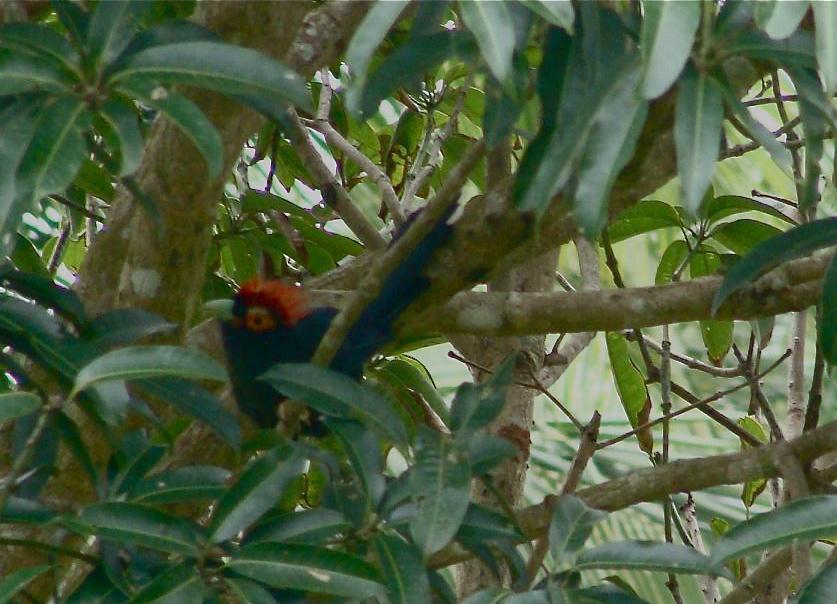
The Red-Crested Malkoha is the bird that gives its name to our place. Indigenous to Luzon and some parts of the Philippines, it is locally called Manoc-manoc or Tamsiya. Here in the Malarayat foothills and apparently in the neighboring areas within Mounts Makiling and Banahaw, the Red-Crested Malkoha is a fairly common sight but still relatively unknown to everyone.


This is strange as the Malkoha has a very striking appearance: a mid-sized bird with bold colors of black, white, red and green. A conspicuous visitor to the fern garden and the mango orchard, sometimes in pairs but more frequently alone. It has glossy black feathers, a green beak, and bright red plumes on its head. It's fairly easy to photograph it since it flies low, and takes short flights between trees.